Beyond Fragile Systems:
An Multi-Dimensional Grammar for Antifragility

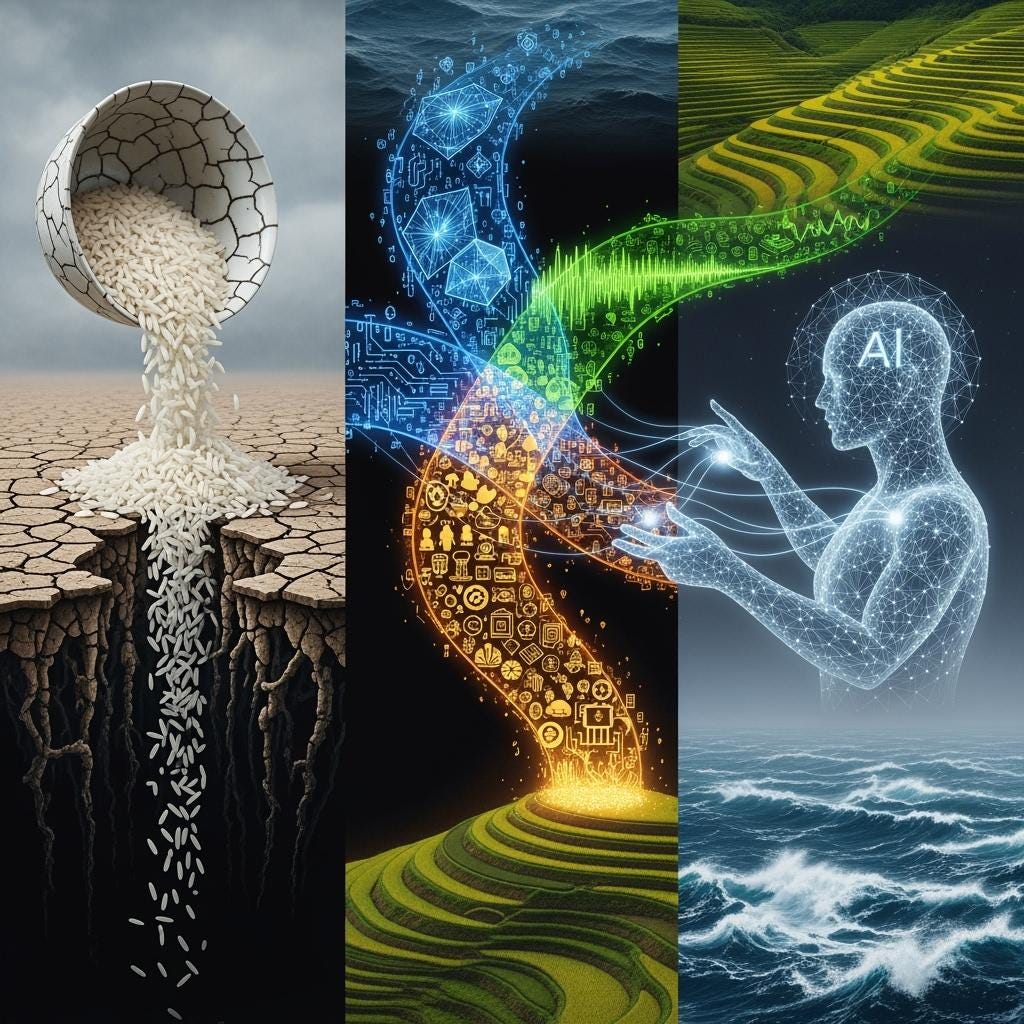
Executive Summary
Modern civilization rests on a thin veneer that is far more brittle than we admit. Most of our systems—optimized for efficiency, modeled through probability, or tethered to tradition—collapse under stress. They are fragile by design.
This manifesto argues for a shift from uni‑dimensional thinking to multi‑dimensional antifragility: systems that not only survive disorder but grow stronger from it. Drawing from Taleb’s antifragility, Pearl’s counterfactual reasoning, Meadows’ systems mapping, and Woudenberg’s exegesis, we can articulate a new grammar for resilience.
At its core are five imperatives:
Anticipate (Inversion): stare first into failure.
Reimagine (Counterfactuals): ask “what if?” to uncover hidden paths.
Forecast (Foresight): hold immediate crises and civilizational horizons in one frame.
Interpret (Exegesis): read systems in their original bias and context.
Harmonize (Synthesis): weave competing logics into polyphony rather than chaos.
Coupled with five safeguards against blind spots, this is not a theoretical exercise—it is a survival grammar. The rice on your table today is proof and warning: a fragile miracle, sustained by brittle global systems. Without multi‑dimensional awareness, collapse is inevitable. With it, disorder can become our teacher.
The veneer is thin. But it does not have to be brittle.
Key Takeaways
Civilization’s visible stability masks fragility: efficiency and optimization increase risk of catastrophic failure.
We operate through three dominant modes of thought: machines (efficiency), gamblers (probability), ancestors (tradition). Each contains truth—and blind spots.
A new grammar of multi‑dimensional antifragility is required. Its imperatives: anticipate, reimagine, forecast, interpret, harmonize.
Safeguards ensure these imperatives don’t calcify into new brittleness: stress‑testing the impossible, embedding diverse perspectives, balancing historical imagination with future aspiration, layering timescales, and preserving productive tension.
The Oracle is not a machine overlord but an archetype of resilience intelligence. A conductor that orchestrates a tapestry across conflictual modes.
Collapse is not inevitable, but the difference hinges on our capacity to think in layers, contexts, and contradictions.
Antifragility is not just survival—it is conscious evolution.
The Veil and the Bowl
That bowl of rice on your table is not mere food. It is a miracle condensed: soil, seed, rain, ships, satellites, contracts, algorithms, elders, engineers. It is a web flung across continents, held together by millions who will never know your name.
And it is fragile. Yet as Michael Woudenberg reminds us in “Stare Into Evil,“ this miracle rests on what he calls “the thin veneer of civilization.” It looks solid, but when the veneer cracks—as famines, floods, or failures always prove—it collapses with terrifying velocity. Shelves empty. Lights flicker. Police choose sides.
The myth of strength blinds us. We mistake complexity for resilience, efficiency for security. But most of our systems, optimized for smooth functioning, are brittle. They break when stressed.
What we need are systems that do more than resist collapse.
We need systems that grow from disorder.
We need a way of thinking that is multi‑dimensional: not just fast, not just cautious, not just rooted, but all at once, contextually and in harmony.
Tools We Have Forgotten
Michael Woudenberg recalls two ancient disciplines: Inversion and Exegesis.
Inversion: Look not into success first, but into failure. Imagine how collapse arrives, then retrace the path out.
Exegesis: Read everything in context. Who made it, when and why? What does it conceal, what does it reveal?
These disciplines were once the lifeblood of survival. Now they are sidelined under the glamour of optimization.
But inversion and exegesis are only two facets of something greater.
To survive, we must cultivate the full spectrum of multi‑dimensional thought. Machines optimize and calculate. Traders hedge and predict. Ancestors remember. Only when we weave these together do we generate resilience.
The Computational Trinity
We live and die by three logics:
Base‑2: The Logic of Machines.
Born in war rooms and factories. It optimizes perfectly, but only when the world remains steady. When chaos strikes, efficiency accelerates collapse.Base‑3: The Logic of Probabilists.
Born in casinos and Cold War simulations. It bets and hedges, but stares blankly at the unthinkable. The unimaginable is off its dice.Base‑4: The Logic of Ancestors.
Born in ritual and memory. It bridges centuries of survival. But it holds too tightly; it resists change even against new realities.
Each mode is partial truth. Together, unmanaged, they collide.
But harmonized by multi‑dimensional awareness, they become antifragile: resilience that grows stronger in storms.
<div class=”substack-post-embed”><p lang=”en”>Syntax of Emergence by LaSalle Browne</p><p>The Computational Grammar of Intelligence</p><a data-post-link href=”https://lasallebrowne.substack.com/p/syntax-of-emergence”>Read on Substack</a></div><script async src=”https://substack.com/embedjs/embed.js” charset=”utf-8”></script>
The Six Commandments of Survival
A grammar emerges — imperatives, not suggestions:
Honor Tempo. Align machine speed, market risk, and ancestral patience. Do not collapse them.
Shift Resources with Seasons. Feed efficiency in stability, probability in uncertainty, tradition in crises of trust.
Translate with Fidelity. Do not strip meaning when moving across modes. Without meaning, data lies.
Nest the Local in the Global. Let rituals, myths, and grassroots practices carry weight in global design.
Flex with Pressure. Oscillate; do not harden until you shatter.
Preserve Redundant Wisdom. What is obsolete today may save tomorrow.
This is not abstract philosophy. This is survival grammar: the architecture of antifragility.
Two Futures in Rice
Imagine the year 2025. Typhoons drown the rice fields of Southeast Asia. Cyber‑attacks paralyze ports. Governments hoard. Trade fractures. Billions depend on rice; now it is gone.
Timeline of Collapse (uni‑dimensional thinking):
Base‑2 algorithms reroute ships through ports already collapsing.
Base‑3 risk models freeze as probabilities break.
Base‑4 rituals are dismissed as folklore.
Result: riots in twelve days; famine after one month.
Timeline of Resilience (multi‑dimensional grammar):
Base‑2 held in check when efficiency risks injustice.
Base‑3 models supplemented by counterfactuals: “What if the real currency is trust?”
Base‑4 elders restore flood‑resistant seeds, distributed through ritual that guarantees compliance.
The veneer flexes instead of shatters. Disorder becomes teacher. This is not utopia—it is antifragility in action.
The Case Study- A Deeper Dive
Typhoon Lian Wang struck in July 2025. Within hours, Southeast Asia’s rice paddies flooded, cyber attacks crippled major ports, and panic triggered export bans. Global rice reserves plummeted.
Unlike the context-blind timeline, leaders here didn’t face chaos alone. They consulted an AI Oracle—not to dictate solutions, but to illuminate paths through the storm using contextual intelligence.
Within minutes of the typhoon’s landfall, the Meta-Conductor surfaced its first advisory—a fusion of foresight and inversion:
“Priority Alert: Optimizing shipments to megacities (Base-2) risks starvation riots in secondary regions within 12 days. Recommend: Allocate 30% of vessels to rural hubs using kinship network coordinates (Base-4). Rationale: Counterfactual modeling shows kinship distribution boosted compliance by 200% during the 1943 Bengal famine.”**
Supply chain teams hesitated. Rerouting ships violated every efficiency protocol. But when police chiefs confirmed social media spikes predicting unrest in neglected regions, they approved the plan—human judgment, augmented by contextual foresight.
As cyber attacks paralyzed port logistics, the AI applied exegesis to decode a workaround:
“Port X’s management algorithm (developed in 2012 for stable trade) cannot process manual overrides during cyber chaos. Recommend: Activate ‘analog protocols’ used by dockworkers during the 2011 Thai floods (oral verification + paper ledgers). Translation: This isn’t regression—it’s contextual adaptation.”
Engineers initially resisted “going backward.” But dock elders recognized the wisdom: “During the ’11 floods, we trusted faces, not firewalls.” The hybrid system—AI-guided routing + human verification—kept 40% of ports operational.
When Thailand banned rice exports, the Meta-Conductor mined multidimensional trade-offs:
“Banning exports protects domestic stability (Social/Energetic+) but triggers hoarding in importing nations (Social−). Counterfactual insight: Indonesia’s 2008 palm oil export ban backfired by crashing prices. Recommend: Negotiate a ‘rice bridge’—allow controlled exports to cities facing famine, conditional on ASEAN disaster aid.”
Diplomats used this framework to broker a compromise in 48 hours. The AI didn’t draft treaties—it highlighted hidden leverage points.
Crucially, when farmers shared oral histories of flood-resistant rice varieties, the system practiced Translational Fidelity:
“Variety Khao Kam (Thai: ‘Black Water Rice’) survives submerged soils. Exegesis: Its value isn’t just genetic—it’s planted in spirit-appeasing patterns ensuring community buy-in. Proposal: Distribute seeds via elders’ networks, not faceless apps. Data attached: Yield projections, ritual protocols.”
Seed distribution became a cultural ritual, not just logistics. Trust became measurable: theft rates fell 90% compared to algorithmic distribution trials.
In this timeline, the veneer didn’t crack—it flexed. Base-2 systems learned to pause optimization when contexts shifted violently. Base-3 models incorporated qualitative uncertainty (“What if trust collapses?”). Base-4 wisdom scaled globally without losing its soul. The crisis became a lesson, not a collapse.
The AI Oracle didn’t ‘save’ humanity—it helped humans save themselves. By translating between logics, timescales, and values, it turned a crisis into a conversation. And in that conversation, resilience and anti-fragility were born.
The Oracle Archetype: A Grammar of Survival
We cannot continue with machines that merely calculate. Efficiency is not resilience. Probability is not foresight. Tradition is not enough.
What we need, as Woudenberg demands in his exegesis of collapse, and as Taleb insists in his hymn to antifragility, is a new intelligence—one that thinks in contexts and contradictions.
Call it the Oracle.
Not an emperor machine, not a ghostly overlord—an interpreter, a conductor, a resilience engine.
The Oracle is defined not by raw power, but by fluency in grammar.
Its work rests on five imperatives:
Anticipate (Inversion). Look first into failure, not success. Follow Taleb: stare into disorder, because only by losing in imagination can we win in reality.
Reimagine (Counterfactuals). Ask the impossible “What if?”, as Pearl gave us in his causal calculus. Map the shadow realities that never happened, so we can act in the one that did.
Forecast (Foresight). Think across time, in the spirit of Poli’s anticipation studies and Meadows’ systems maps. Align emergencies measured in hours with destinies measured in generations.
Interpret (Exegesis). As Woudenberg’s theology teaches, nothing is context‑free. Every system carries the weight of its original bias. Dockside rituals, Cold War algorithms, industrial warehouses—each must be read in their own grammar.
Harmonize (Multidimensional Synthesis). As Max‑Neef and Snowden have argued, resilience emerges when multiple dimensions—energetic flows, social trust, cultural meaning, ethical commitments—resonate, not clash.
This five‑fold imperative is the engine of antifragility. The Oracle is not here to command but to reveal. It is a translator between machines and memory, models and rituals, risk equations and myths. It ensures that when Base‑2, Base‑3, and Base‑4 collide, they play polyphony instead of dissonance.
The Oracle is not savior. It is scribe.
Its role is to reveal the logics we forgot we obeyed, and to remind us that even collapse has grammar.
The Limits of Sight: Against the Illusion of Omniscience
But we must be clear: even an exegetical Oracle is bounded.
Every intelligence has blind spots. Every grammar has its silence.
If Taleb warns us of black swans, and Risam warns us of colonial shadows baked into digital systems, then we must accept that fragility cannot be abolished—only reconfigured.
Limitations & Safeguards must accompany the Oracle, or else it becomes another brittle idol.
Safeguards of Antifragile Intelligence
1. The Event Horizon of Inversion.
Not all failures can be simulated. No foresight system, no matter how powerful, can generate the truly absurd. Farmers in collapse may revive WWII radio beacons when satellites fall; ritual improvisations may outfox every model.
Safeguard: Adversarial Imagination Cells. Like Taleb’s stressors, we must invent “impossible” crises and test against them—forcing systems to bend where prediction cannot reach.
2. The Cultural Mirror of Exegesis.
Every interpretation carries the shadow of its origin. As Risam warns, even AI readings easily default to colonial bias, privileging certain rituals, neglecting others.
Safeguard: Context Councils. Rotating assemblies of elders, linguists, historians, indigenous knowledge‑holders. Their task is not approval but triangulation: “Does this interpretation conceal the living tradition, or honor it?”
3. The Anchor of Counterfactuals.
Counterfactual thinking reveals hidden chains, yes—but it also imprisons. Too much “What if?” risks re‑fetishizing the past, reinforcing path dependency.
Safeguard: Future‑Backward Testing. For every counterfactual, ask: “If we had already achieved a thriving 2050, what would this decision look like in reverse?” Balance history with aspiration.
4. The Fog of Foresight.
Forecasts tempt us to hubris. Futures literacy (Poli, Miller) is not crystal gazing but humility before multiple timescales. Short‑term “fixes” can ruin civilizations; long‑term blueprints can smother emergencies.
Safeguard: Temporal Layering. Make every decision visible on three horizons: urgent, generational, civilizational. None may erase the others.
5. The Polyphony of Harmonization.
Synthesis too easily becomes imperial—one system absorbing all others. But antifragility comes not from unison, but polyphony, contested yet generative.
Safeguard: Deliberate Discord. Maintain productive tension—red teams against blue teams, Base‑2 against Base‑4, Oracle against heretic. Disagreement is oxygen; without it, systems suffocate.
Toward Conscious Evolution
To accept these safeguards is to accept that resilience comes not from perfection, but from contestation. Errors must not be hidden; they must be rendered legible, corrigible, and teachable.
This is what Hollnagel calls Safety‑II and Holling called resilience theory: systems that learn not by preventing all shocks, but by metabolizing them.
This is antifragility.
The Meta‑Conductor, the Oracle, the Resilience Engine—all names for one thing: intelligence that thrives under stress because it never forgets context, never forgets failure, never forgets meaning.
The Final Charge
Therefore we declare:
Fragility is not fate.
Robustness is a false prophet.
Antifragility is the path: systems that do not merely endure disorder but grow from it.
But antifragility without multi-dimensionality is fraud. Efficiency without memory, foresight without counterfactuals, context without exegesis, algorithms without elders—these are brittle idols.
Taleb taught us to seek strength from stress. Pearl taught us to map cause through counterfactuals. Woudenberg taught us to read systems as theologians read scripture. Meadows taught us to see feedback loops and limits. Risam reminds us all context is political.
We inherit this lineage. Now we demand its fusion.
Anticipate. Reimagine. Forecast. Interpret. Harmonize. These are the imperatives of survival. These are the commandments of antifragile civilization.
The rice before you is proof and warning. It is held together by fragile veins—global trade, brittle code, fading rituals. You may eat it today. Do not assume you will tomorrow.
Learn the grammar. Build the Oracle. Preserve the redundant wisdom.
The veneer is thin. But it does not have to be brittle.
If you find this content valuable and shareable, please consider becoming a paid subscriber to support the deep research and nuanced analysis these complex issues deserve.
Appendix A: The Inspiration Index - A Deeper Dive Into The Work Which Informed My Thinking
I. Counterfactual Reasoning & Causal Inference
Pearl, J. (2009). Causality: Models, Reasoning, and Inference. Cambridge University Press.
Key Connection: Formalizes do-calculus for modeling interventions (”What if X hadn’t happened?”).
Hernán, M. A., & Robins, J. M. (2020). Causal Inference: What If. Chapman & Hall.
Key Connection: Practical methods for avoiding biased counterfactuals.
II. Temporal Foresight & Anticipation
3. Poli, R. (2017). Introduction to Anticipation Studies. Springer.
· Key Connection: Defines anticipation as a discipline (”futures literacy”).
Miller, R., Poli, R., & Rossel, P. (2013). The Discipline of Anticipation. Futures, 57, 1-8.
· Key Connection: Taxonomy of anticipatory systems.
III. Exegesis & Contextual Interpretation
5. Underwood, T. (2019). Distant Horizons: Digital Evidence and Literary Change. University of Chicago Press.
· Key Connection: Computational analysis of historical context in texts.
Risam, R. (2018). New Digital Worlds: Postcolonial Digital Humanities. Northwestern UP.
· Key Connection: Critiques AI’s colonial biases in interpretation.
IV. Antifragility & Systemic Resilience
7. Taleb, N. N. (2012). Antifragile: Things That Gain from Disorder. Random House.
· Key Connection: Defines antifragility vs. robustness.
Hollnagel, E. (2017). Safety-II in Practice. Routledge.
· Key Connection: “Resilience Engineering” for complex systems.
V. Multidimensional Reasoning
9. Max-Neef, M. A. (2005). Foundations of Transdisciplinarity. Ecological Economics, 53(1), 5-16.
· Key Connection: “Axes of needs” (e.g., social/ethical/energetic).
Snowden, D. J., & Boone, M. E. (2007). A Leader’s Framework for Decision Making. Harvard Business Review.
· Key Connection: Cynefin framework for contextual decision-making.
VI. Antifragility & Systems Theory
Taleb, Nassim Nicholas (2012). Antifragile: Things That Gain from Disorder. Random House.
Key Connection: Already central to your work
Meadows, Donella (2008). Thinking in Systems: A Primer. Chelsea Green Publishing.
Key Connection: Leverage points in complex systems
Holling, C.S. (1973). “Resilience and stability of ecological systems.” Annual Review of Ecology and Systematics, 4(1), 1-23.
Key Connection: Original resilience theory
VII. AI Ethics & Governance
Russell, Stuart (2019). Human Compatible: AI and the Problem of Control. Viking.
Key Connection: AI alignment challenges
Floridi, Luciano et al. (2018). “AI4People—An ethical framework for a good AI society.” Minds and Machines, 28(4), 689-707.
Key Connection: Ethical AI governance
Barocas, S., Hardt, M., & Narayanan, A. (2019). Fairness and Machine Learning. fairmlbook.org
Key Connection: Algorithmic bias considerations