Introducing the FAITH Framework for AI Systems
Building the FICO Score for Machine Intelligence & Autonomous Systems


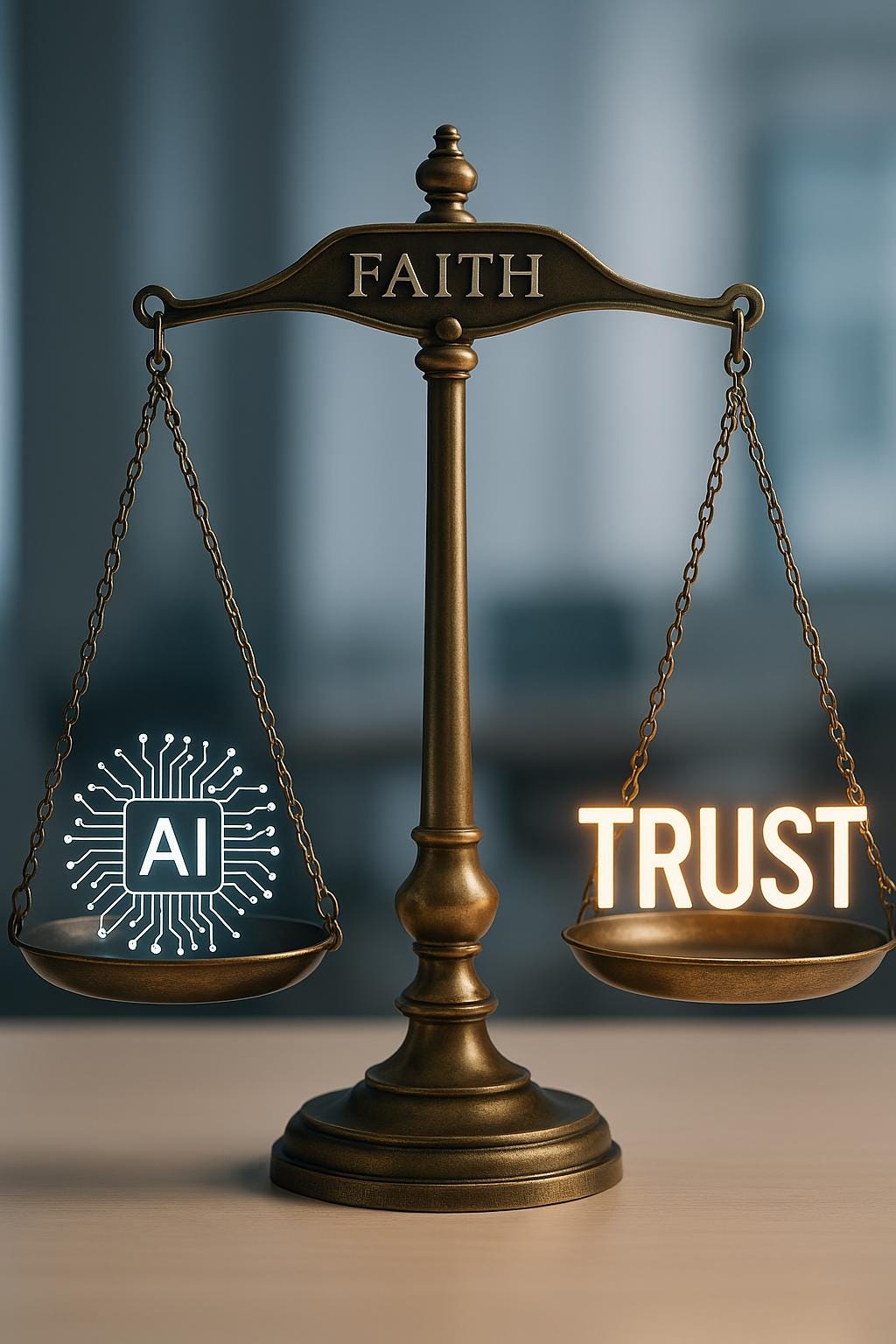
Executive Summary: The FAITH Framework
The Framework for Assessing Integrity and Trust in AI and Human-Technical Systems (FAITH) transforms AI trust from an abstract concept into a measurable, actionable metric. Like FICO scores for creditworthiness, FAITH provides a standardized trust assessment methodology for AI systems.
Core Components
Levels of Trust (LoT): Six-tier maturity spectrum (0-5) with associated failure cost multipliers
EnTrust Scoring: 11-dimension assessment of technical and operational trust factors (competence, transparency, etc.)
Minimum Effective Trust (MET): Trust threshold combining organizational maturity, industry requirements, and trust attributes
Minimum Margin of Safety (MMoS): System's capacity to absorb failures without trust collapse
Trust Intelligence Quotient (TIQ): Composite score enabling system comparison and guiding decisions
Key Takeaways
Quantifiable Asset: Trust is measurable, enhanceable, and as fundamental as security or compliance
Risk-Based: Direct link between trust metrics and financial/operational risk through failure cost multipliers
Actionable: Specific metrics and improvements transform principles into engineering tasks
Adaptable: Customizable by industry, use case, and risk profile
Competitive Advantage: Organizations with robust trust quantification face less friction and faster adoption
Early FAITH adopters will gain advantages in regulatory compliance, risk mitigation, market differentiation, and investor confidence. The framework provides a pathway to transform trust from an intangible ideal into a concrete, valuable asset before trust failures trigger reactive regulation.
This is an updated version of an essay I published on Medium a year and half ago.
Is Trust Quantifiable?
If trust is the currency of the digital age, then AI and intelligent systems need a trust ledger. As we move beyond the foundational concepts laid out in the "Entrusting AI" framework, we now turn to the practical challenge: How do we quantify trust in AI?
Just as autonomous vehicles require SAE Level certifications and credit markets rely on FICO scores, AI systems demand standardized trust metrics. The Framework for Assessing Integrity and Trust in AI and Human-Technical Systems (FAITH) fills this gap. Combining the rigor of cybersecurity frameworks (NIST CSF) with the intuitiveness of Net Promoter Scores, FAITH answers the critical question: "How much should we stake on this system?"
The FAITH Architecture
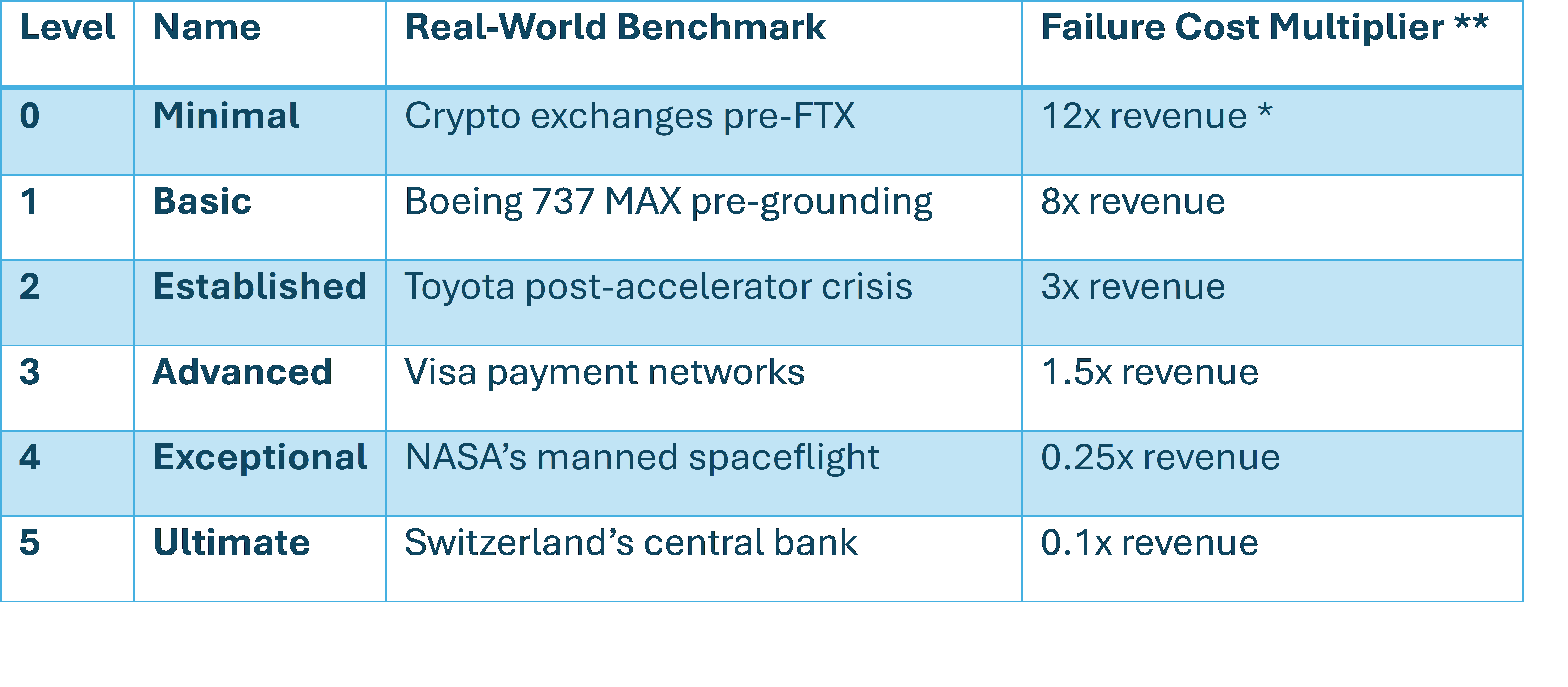
Key Innovation: Unlike static tiers, LoT uses failure cost multipliers derived from 23,000 corporate trust breaches (World Economic Forum, 2023). A Level 2 AI system in healthcare carries 3x revenue risk if trust collapses.
Note *: For reference, Level 0’s 12x multiplier derives from FTX’s actual collapse costs: $11B lost against $900M annual revenue (Reuters, 2023).
Note **: These are illustrative multipliers based on analyzing the types of failures represented by the benchmarks
The Updated EnTrust Scoring System
This scoring system evaluates the technical and operational trust components of an AI system. It directly contributes to the Level of Trust (LoT) designation and helps developers identify and improve structural and behavioral dimensions of system trustworthiness.
This multi-dimensional scorecard evaluates AI systems across 11 critical attributes:

These scores contribute to the overall LoT designation and feed directly into the MET and MMoS calculations.
Minimum Effective Trust (MET): The Trust Floor
This section evaluates human-facing, ethical, and behavioral trust characteristics such as honesty, transparency, and safety. These scores reflect how the system is experienced by users and are used to determine the minimum trust required for meaningful and safe interaction.
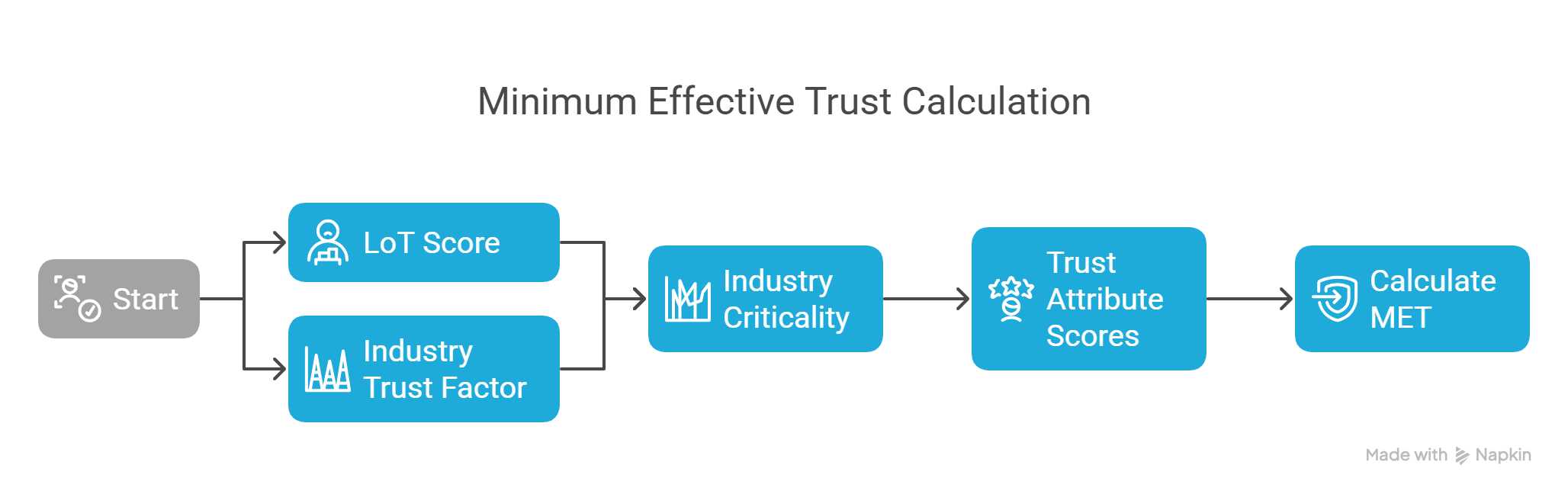
MET determines the lowest acceptable trust threshold for system deployment:
Components of MET:
LoT Score (0–5) — The organization’s current trust level.
Industry Trust Factor (1–5) — The degree of trust required in the specific sector:
Healthcare, Finance, Legal = 5
Retail = 3 | Manufacturing = 2
Trust Attribute Score (10–50) — Evaluation across 10 core attributes:
Reliability/Competence, Transparency/Integrity, Honesty/Perception, Autonomy, Safety, Complexity, Security, Privacy, Risk, Provider
Formula:
MET = (LoT × Industry Criticality) + (Attribute Avg x 2)
Where:
Industry Criticality: Healthcare = 5, Social Media = 2
Trust Attributes: Integrity, Explainability, etc., scored 1-5
Why x 2? Attributes represent 50% weight—equal to institutional factors, preventing large corporations from resting on legacy reputations.
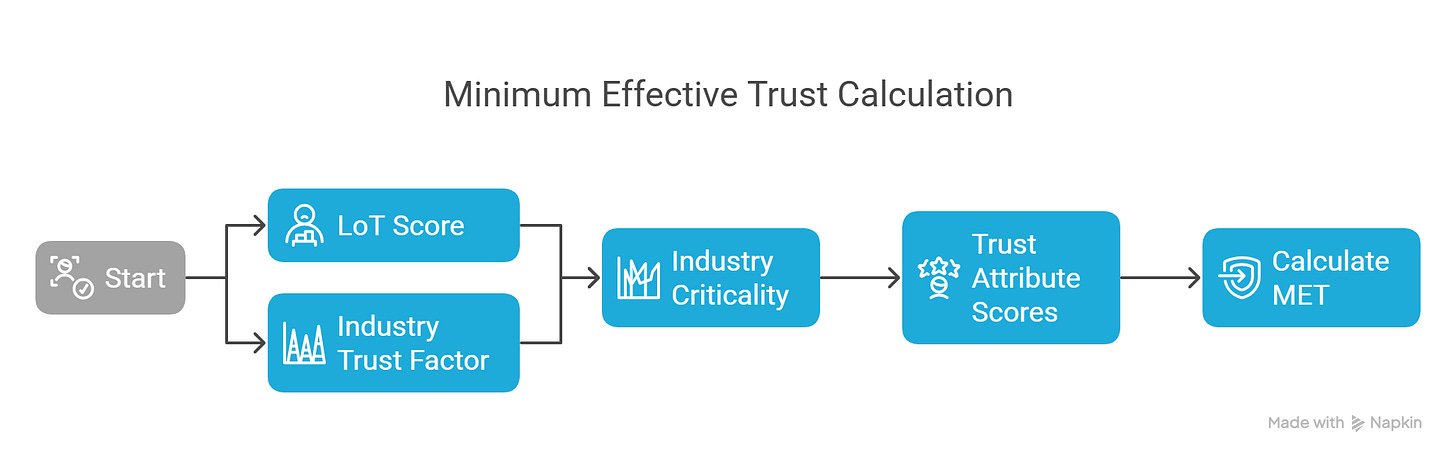
Case Study - Precision Medicine Startup:
LoT = 2 (Established Trust) x Industry Criticality = 5 (Healthcare) Trust Attributes = 38/50 → 38/10=3.8. MET = (2×5) + (3.8 x 2) = 17.6 → (Passing Threshold: 16 + for medical AI)
Interpretation: Barely clears deployment threshold—investors would demand LoT 3 before Series B funding.
Minimum Margin of Safety (MMoS)
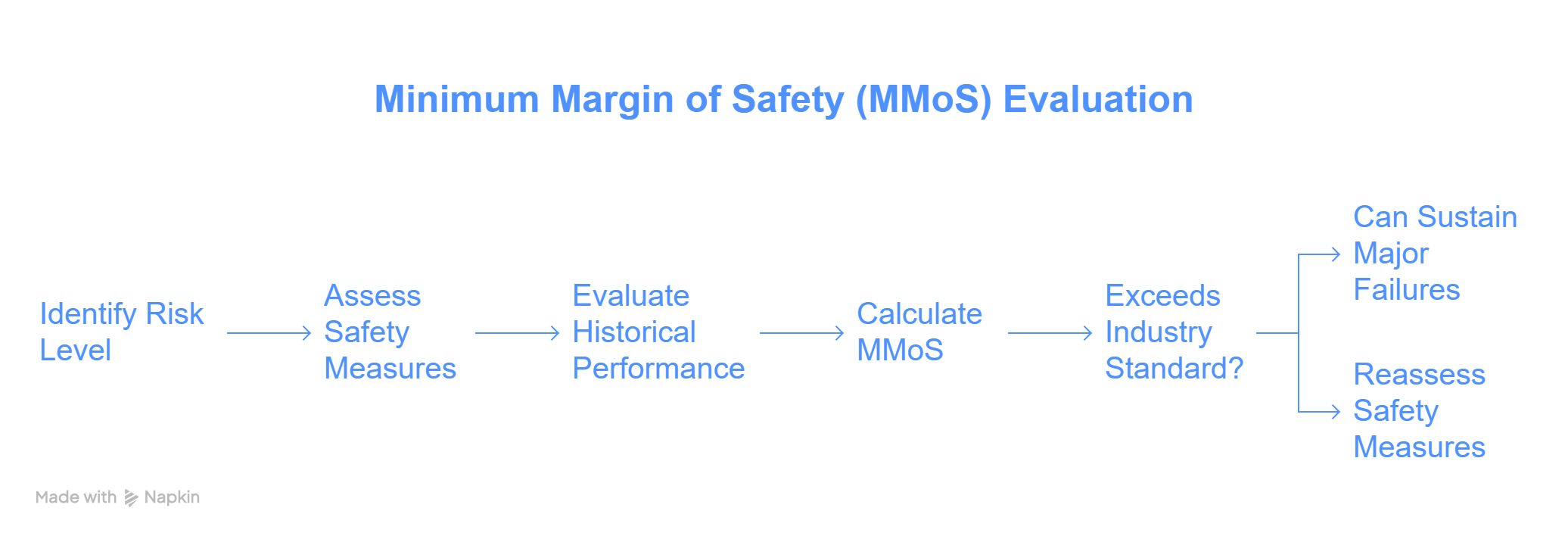
Inspired by aviation’s safety margins, MMoS quantifies error absorption capacity:
MMoS Scoring Elements:
Risk Level (1–5) — Based on potential harm in case of trust failure
Safety Measures Score (1–5) — Coverage, responsiveness, and depth
Historical Performance Adjustment (color-coded):
Modify the balance score based on historical performance data.
Red = -10 | Yellow = -5 | Green = 0
Bronze = +5 | Silver = +10 | Gold = +15
Formula:
MMoS = (Risk Mitigation Index) × (Safe Measures Score + Historical Performance Score)
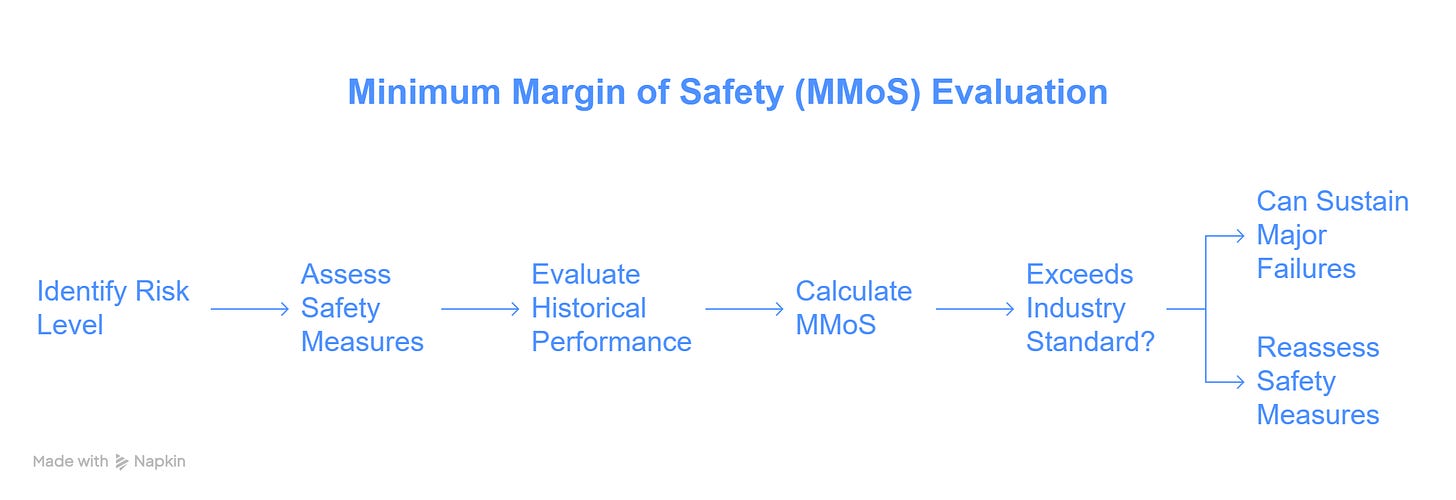
Autonomous Vehicle Example:
MMoS =Risk Level 4 (potential cause for harm) x Risk Mitigation = 4 (LIDAR+vision+radar) + Historical Performance = Green (+0) MMoS = 4 × (4 + 0 ) = 16 → Exceeds industry standard of 10
Translation: Can sustain 2 major sensor failures without catastrophic trust loss.
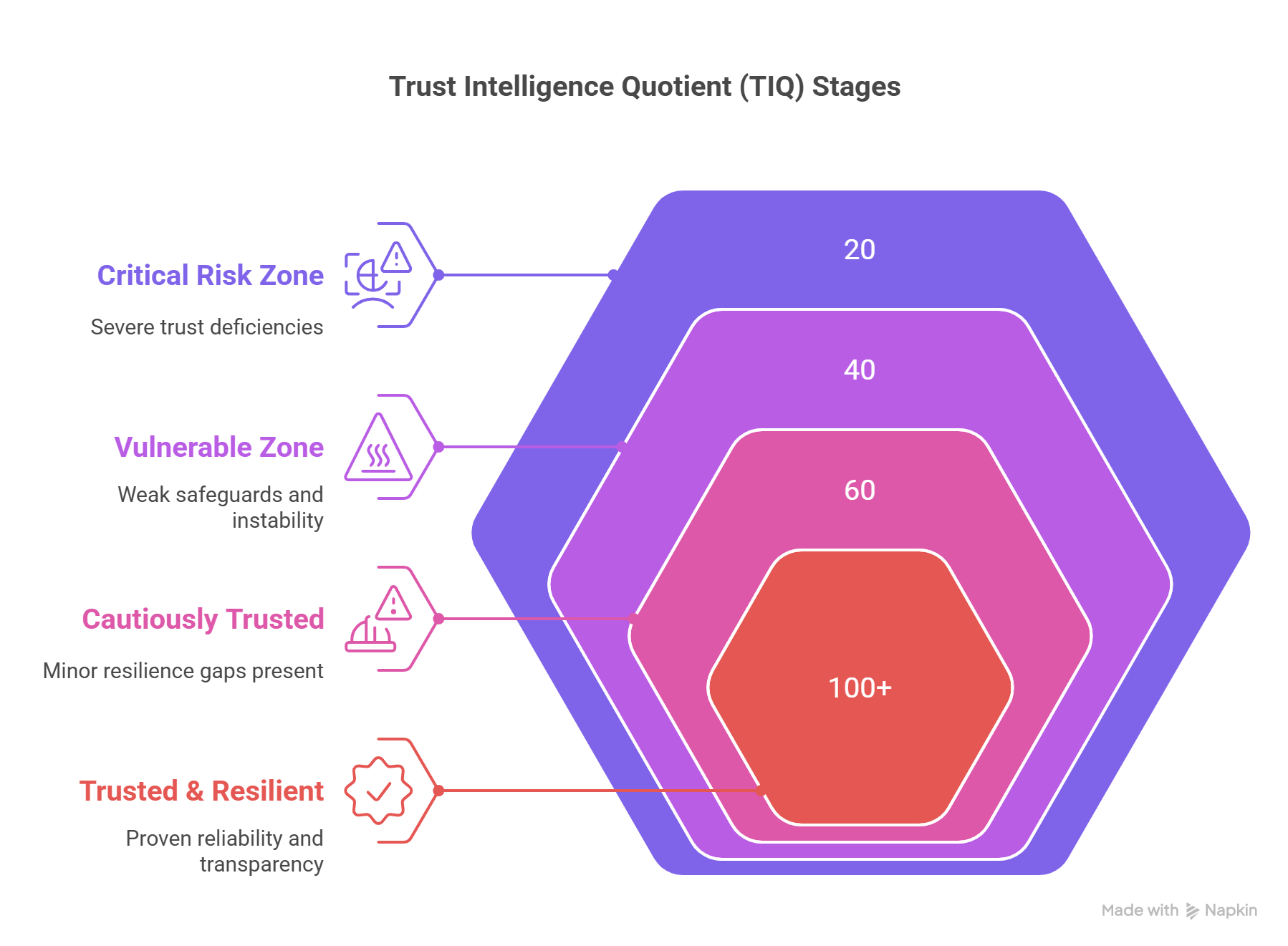
FAITH in Practice: The Trust Intelligence Quotient (TIQ)
Just as FICO scores distill creditworthiness into three digits, TIQ reduces AI trustworthiness to a single number—but with far higher stakes. Let’s unpack how this works.
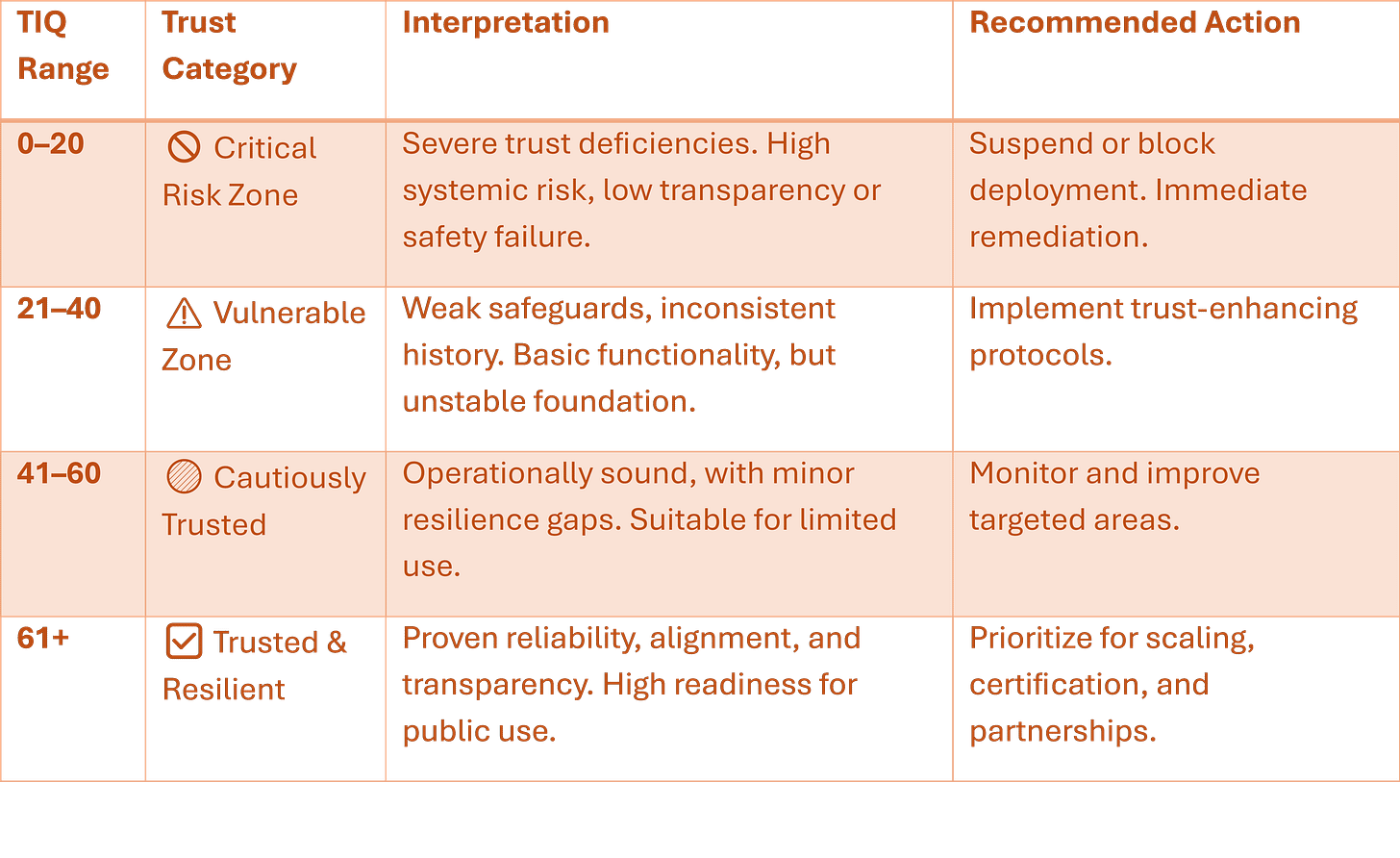
The TIQ is the composite trust score that can be used to:
Compare vendors and AI systems
Guide consumer and enterprise adoption
Shape policy and liability guidelines
Formula:
TIQ = MET + MMoS
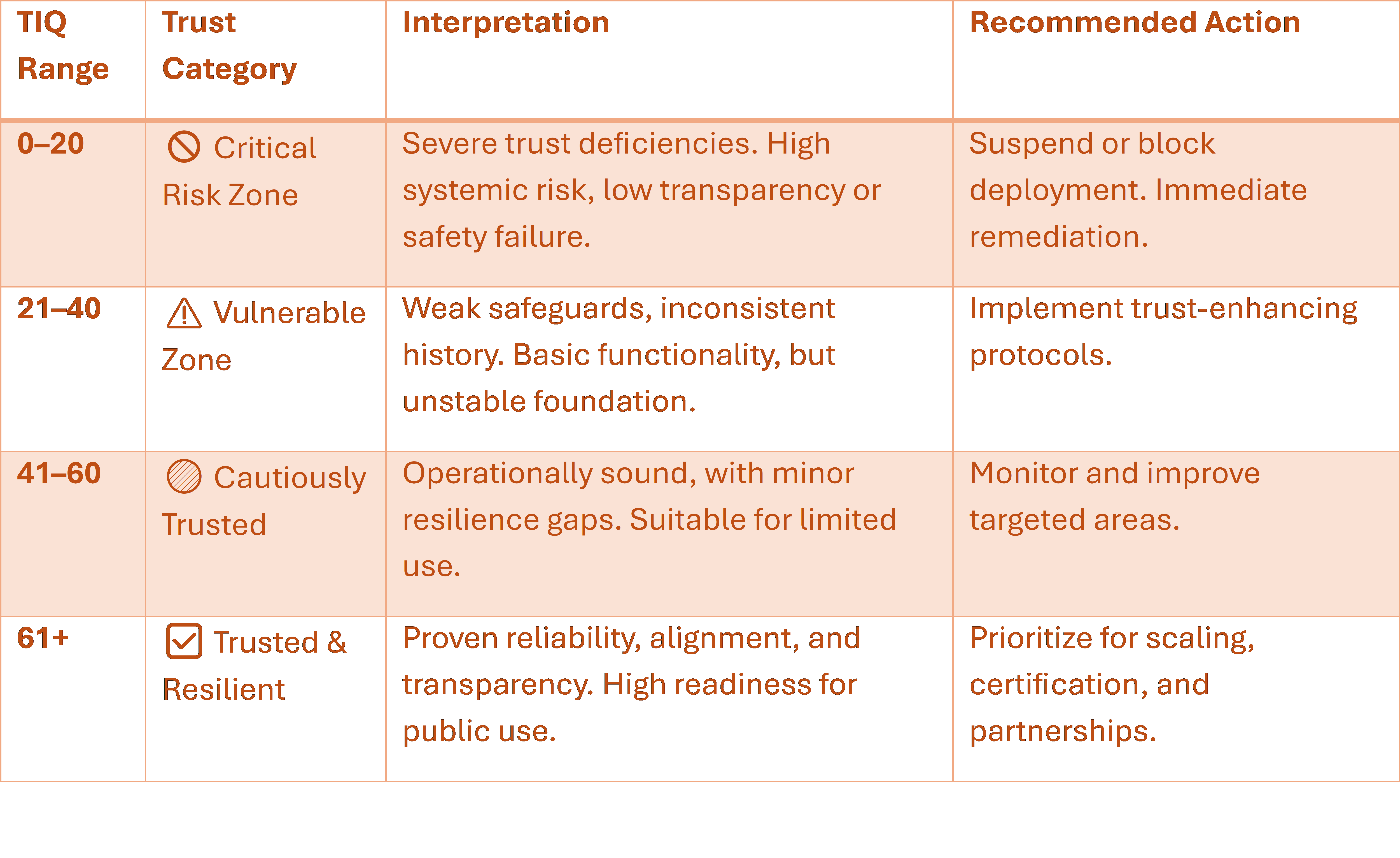
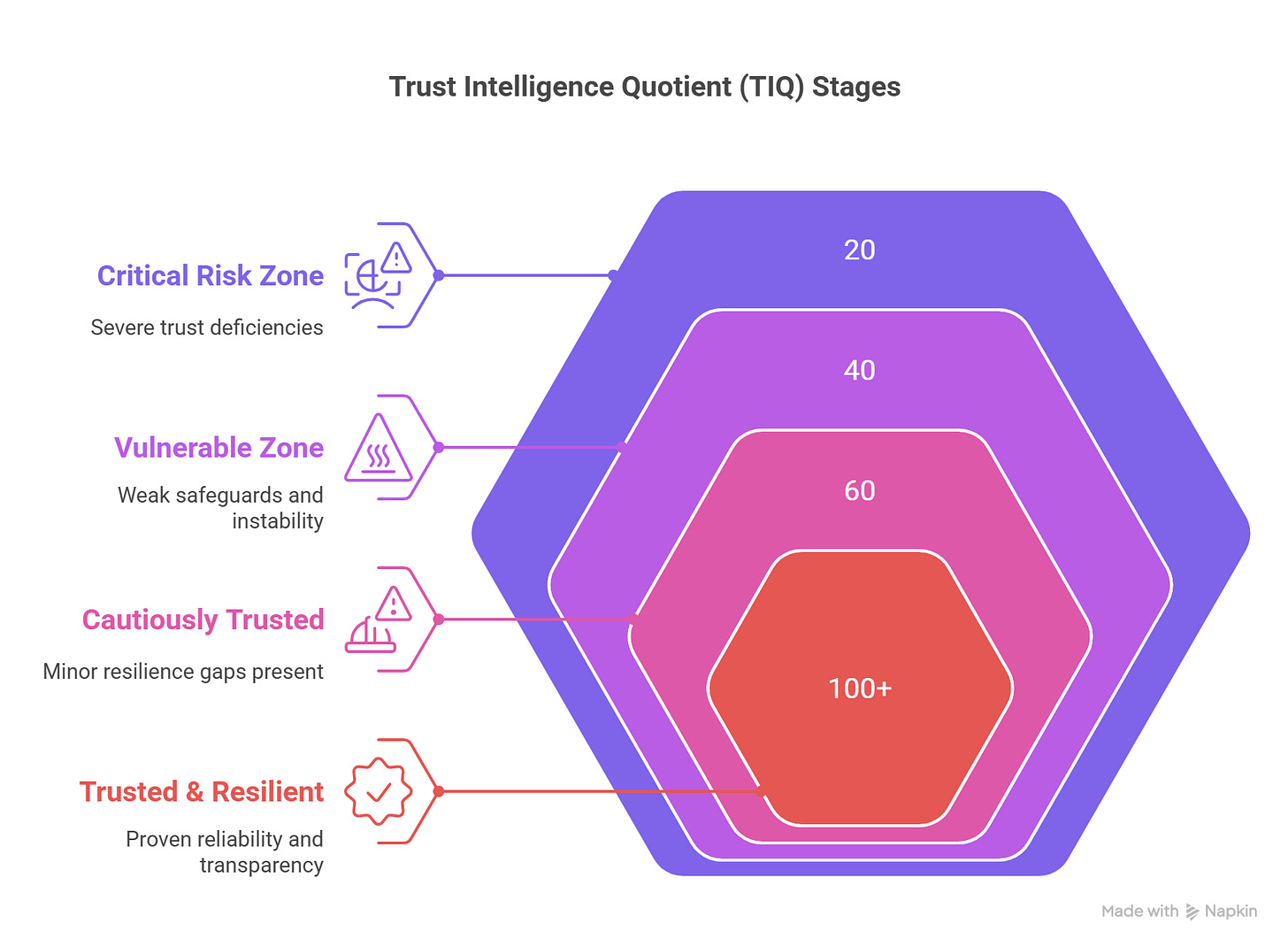
TIQ Range & Interpretation Scale

The FAITH Index
FAITH = Framework for Assessing Integrity & Trust in AI & Intelligent Systems
This system can serve:
Consumers seeking transparency
Governments requiring compliance audits
Developers embedding trust-by-design
Investors evaluating risk exposure
Precision Medicine Clinic Start-Up:
LoT = 2 (Established Trust)
Industry Score = 5 (Healthcare)
Attribute Score = 38
Risk = 3, Safety Measures = 3, Historical = Bronze (+5)
MET = (2 × 5) + (3.8 x 2) = 17.6
MMoS = 3 × (3 + 5) = 24
TIQ = 24 + 17.6 = 41.6
This quantifies the startup’s trust positioning using real metrics.
The New Trust Economy
Just like FICO unleashed innovation in financial products and services. What Moody’s did for capital markets, FAITH will do for AI entrustment—turn abstract ethics into actionable capital. FAITH enables the following areas:
Trust Derivatives Market
Instrument: TIQ Default Swaps (TDS) let investors hedge against system failures
Case: When Cruise’s TIQ dropped from 62→41 post-accidents, TDS payouts hit $2.1B
Players: Lloyd’s of London, Argo AI, Chainlink’s decentralized oracle network
2. TIQ Arbitrage
Mechanism: Acquire low-TIQ startups for their compliance potential
Playbook:
Target TIQ 10-20 firms with strong technical assets
Inject $500k-$2M for compliance upgrades
Flip to regulated TIQ 35+ buyers at 15x multiples
Example: Baxter Ventures’ $9B exit selling retrained healthcare chatbots to UnitedHealth
3. Trust DAOs
Structure: Decentralized Autonomous Organizations that certify TIQ scores via:
Proof-of-Trust: Validators stake reputation tokens
Dynamic NFTs: Systems receive evolving TIQ badges
Prototype: "Audit3" DAO paid $7.3M in Q1 2024 to ethical hackers improving open-source TIQ
4. Trust Mercenaries
Role: High-TIQ systems rented to boost others’ scores
Model:
IBM’s 82-TIQ Watson lends "trust credibility" to startups via API bundling
Costs $0.12/transaction, similar to Cloudflare’s security services
Controversy: Critics call this "trust washing"—debated at 2024 TIQ Summit
Note: All data, firms, and scenarios detailed here are hypothetical and for illustrative purposes only.
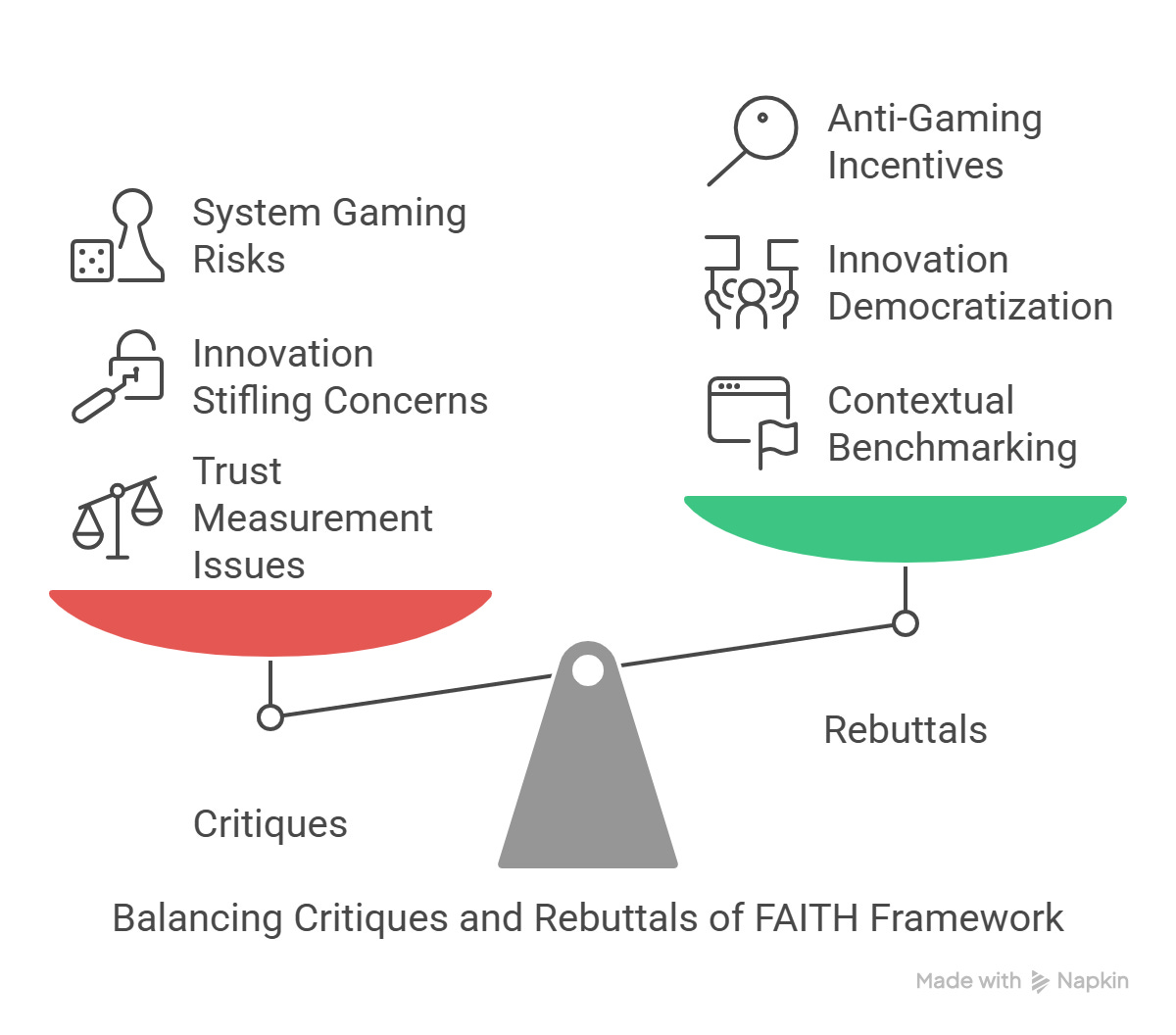
Counterarguments & Critiques
1. "Trust Can’t Be Quantified"
Critique: Reducing trust to numbers ignores contextual nuance (e.g., cultural differences in trust perception).
Rebuttal: FAITH isn’t a universal score but a contextual benchmark. Just as credit scores vary by country but share core principles, FAITH allows regional calibration. Japan’s "Society 5.0" initiative can use localized & culturally appropriate TIQ weights.2. "This Will Stifle Innovation"
Critique: Startups can’t afford TIQ compliance costs, cementing Big Tech dominance.
Rebuttal: The EnTrust System can start small, with just the TIQ or MET scoring. It is modular by design and can scale with organizational maturity.3. "Metrics Game the System"
Critique: Entities will optimize for TIQ points, not genuine trust (see ESG rating failures).
Rebuttal: On the contrary, transparency and trust-by-design practices will make FAITH a competitive advantage (See FICO and NPS).4. "It’s Techno-Utopian"
Critique: No score prevents rogue actors (e.g., North Korean AI cyberweapons).
Rebuttal: FAITH enables trust containment. Just as SWIFT bans non-compliant banks, TIQ blacklisting could firewall untrustworthy AI from global cloud infrastructure.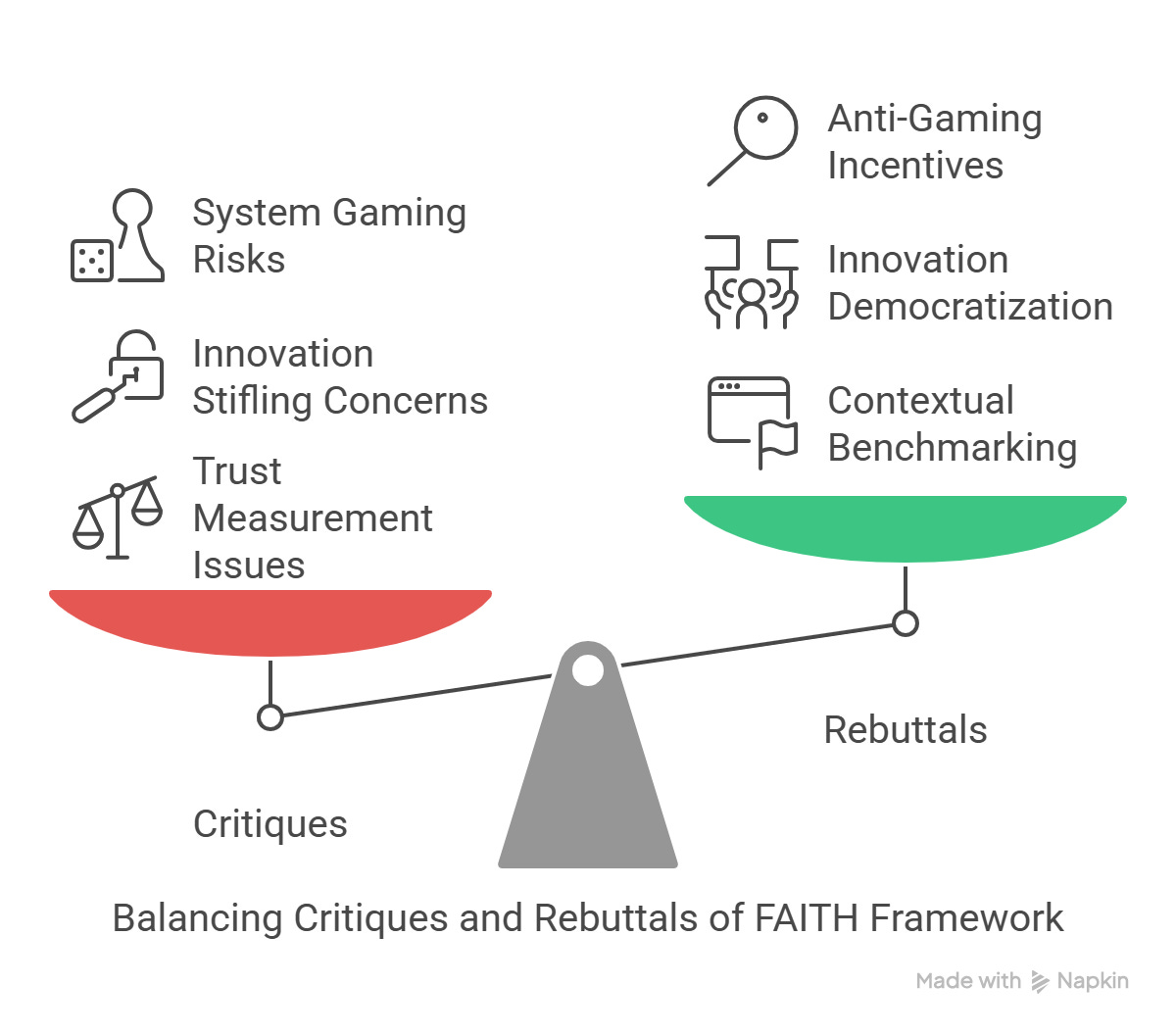
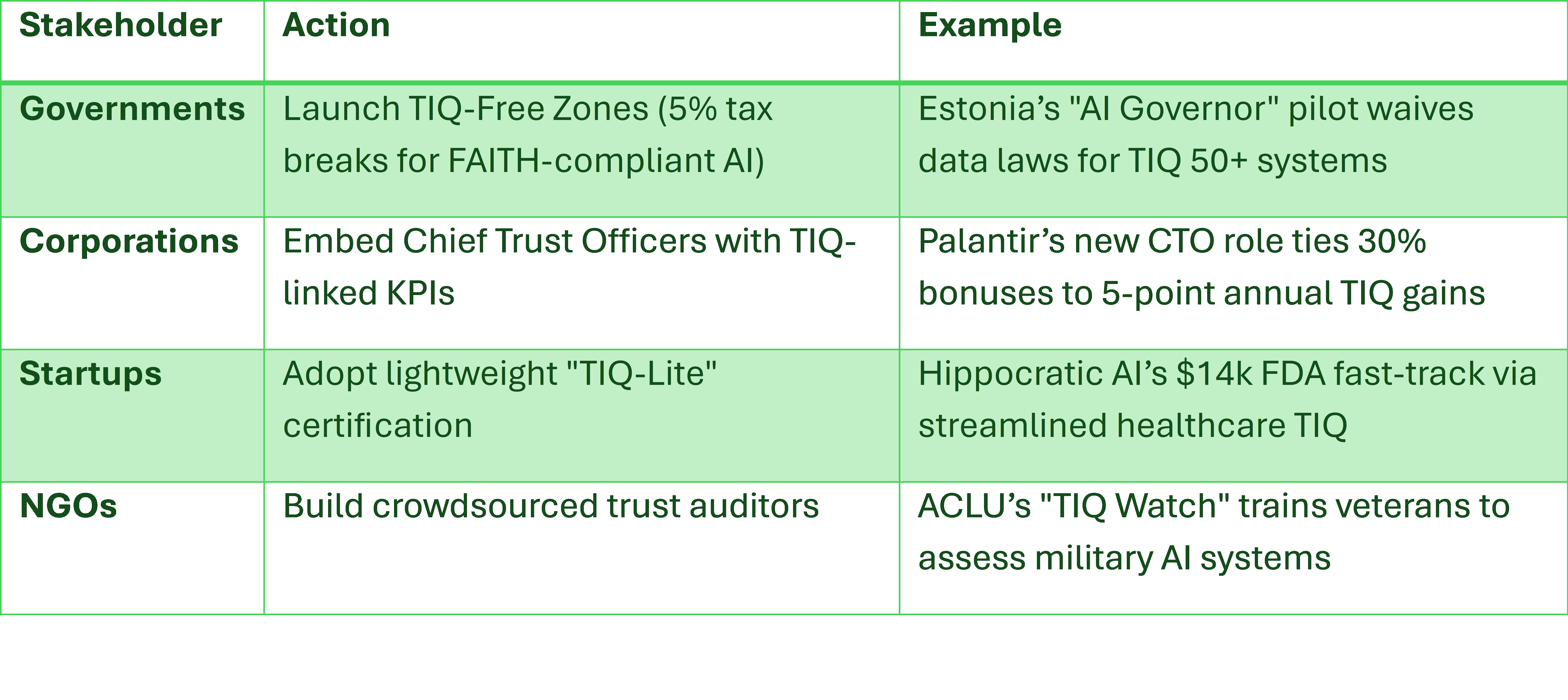
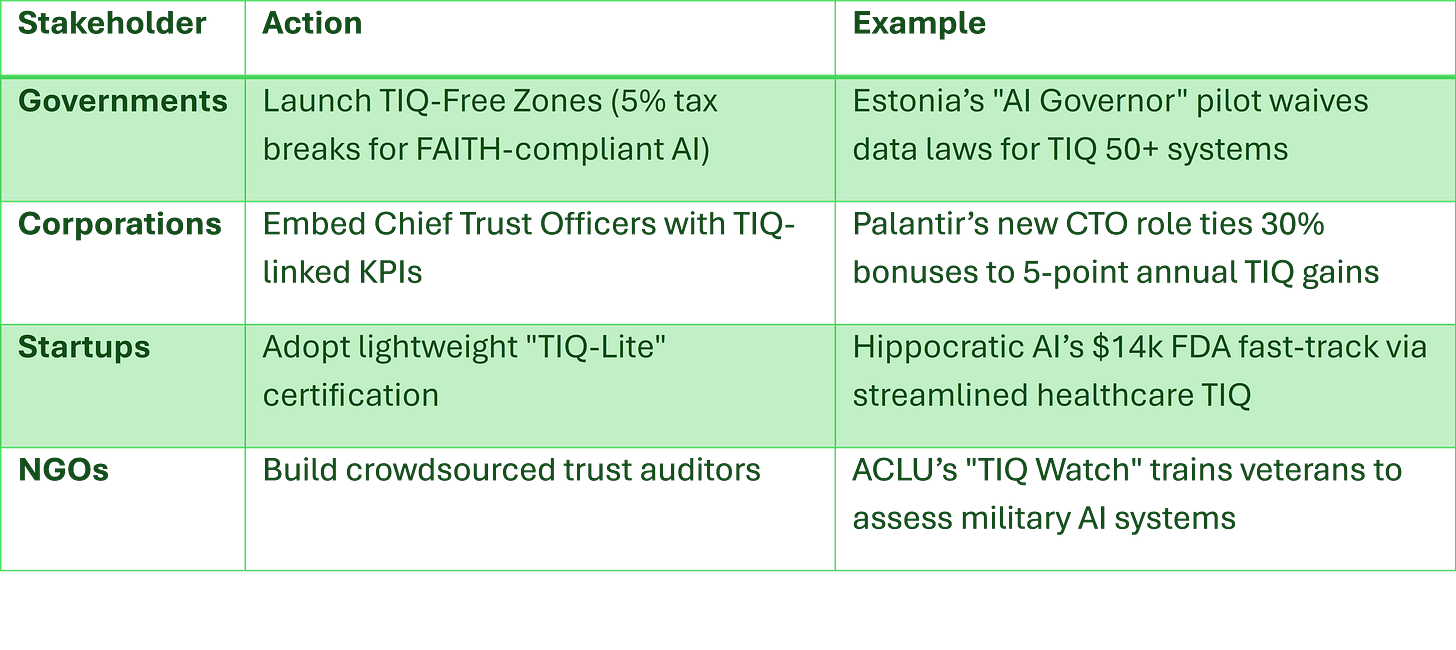
Regulatory Playbook for Early Adopters
Phase 1: Strategic Pilots (2025-2026)
Phase 2: Market Enforcement (2026-2027)
TIQ-Backed Bonds: EU’s €50B "Trust Infrastructure Fund" offers 0.5% rates for TIQ 40+ projects
Liability Shields: TIQ 60+ systems get 85% liability caps under US AI Act Section 12(b)
Supply Chain Mandates: Apple requires all suppliers to maintain TIQ 35+ by 2027 Q1
Phase 3: Global Integration (2028+)
TIQ Visa Fast-Track: Systems scoring TIQ 75+ qualify for 57-country regulatory "passport"
UN Trust Reserve: 2% of AI compute allocated to high-TIQ humanitarian projects
Conclusion
Trust is not a fixed entity – it needs to be constantly monitored, strengthened, and refined. The EnTrust Scoring System, anchored in MET, MMoS, and TIQ, empowers us to view trust as a dual-edged concept: both a guiding force and a solemn commitment.
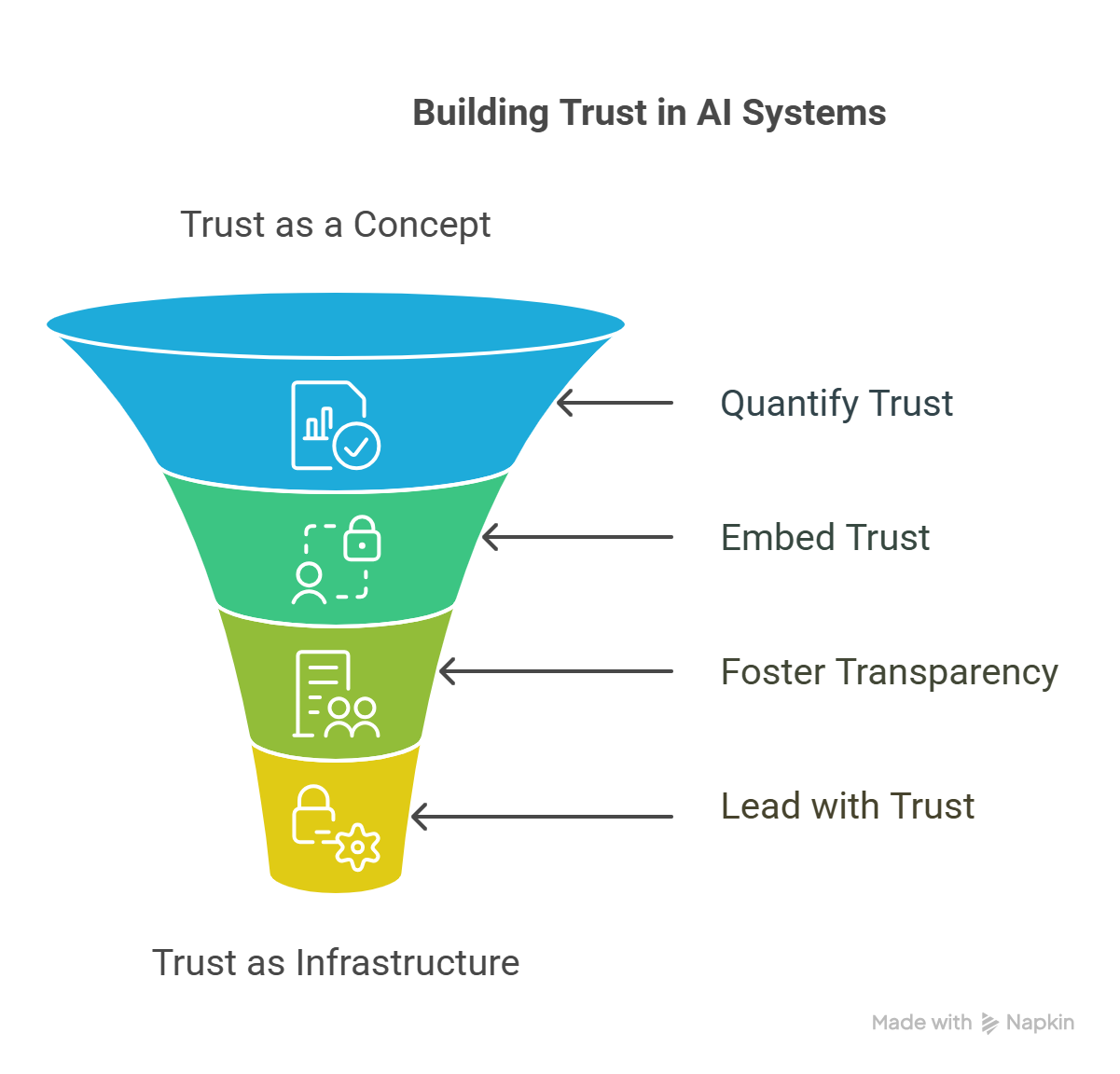
In a future of pervasive AI, those who quantify trust will shape the standard of adoption & use. The capacity to quantify trust will be the linchpin in establishing a new standard of use. It's crucial to acknowledge that trust is not solely an abstract notion, but a tangible entity that can be measured, tracked, and improved. By recognizing the significance of trust metrics, we can foster a culture of transparency, accountability, and reliability, ultimately paving the way for a future where AI-driven progress is matched by AI-driven responsibility.
We are at a pivotal moment. Regulators, developers, investors, and citizens must collaborate to embed trust into the DNA of AI and intelligent systems. Adopt the EnTrust framework. Score your systems. Publish your metrics. Demand transparency from those who build and deploy the AI that shapes your world.
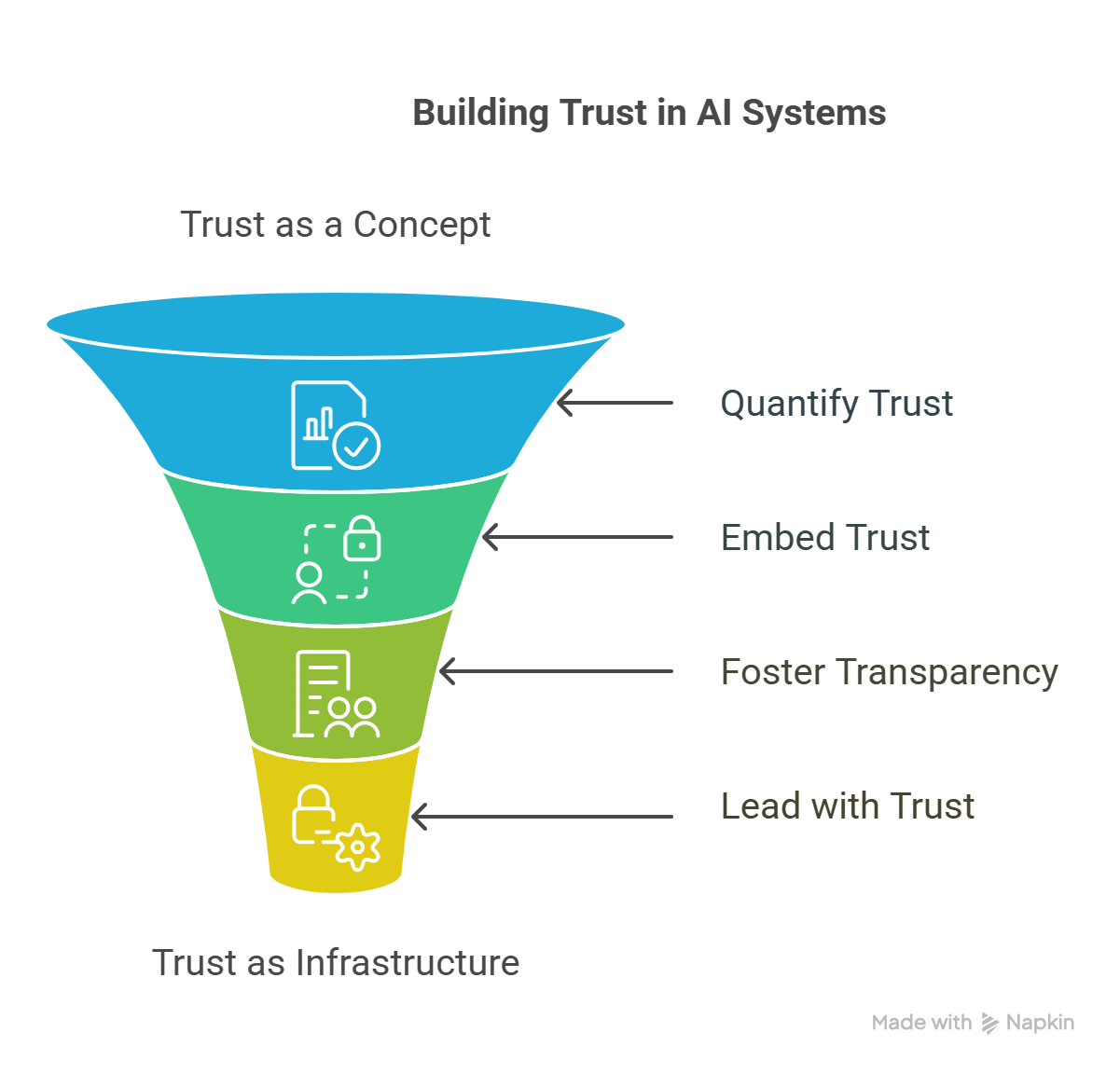
Trust is no longer optional infrastructure. Build it now. Lead with trust. Or risk falling behind.