Longevity Doesn’t Need More Data. It Needs an Operating System.
State Over Data. Coherence Over Optimization

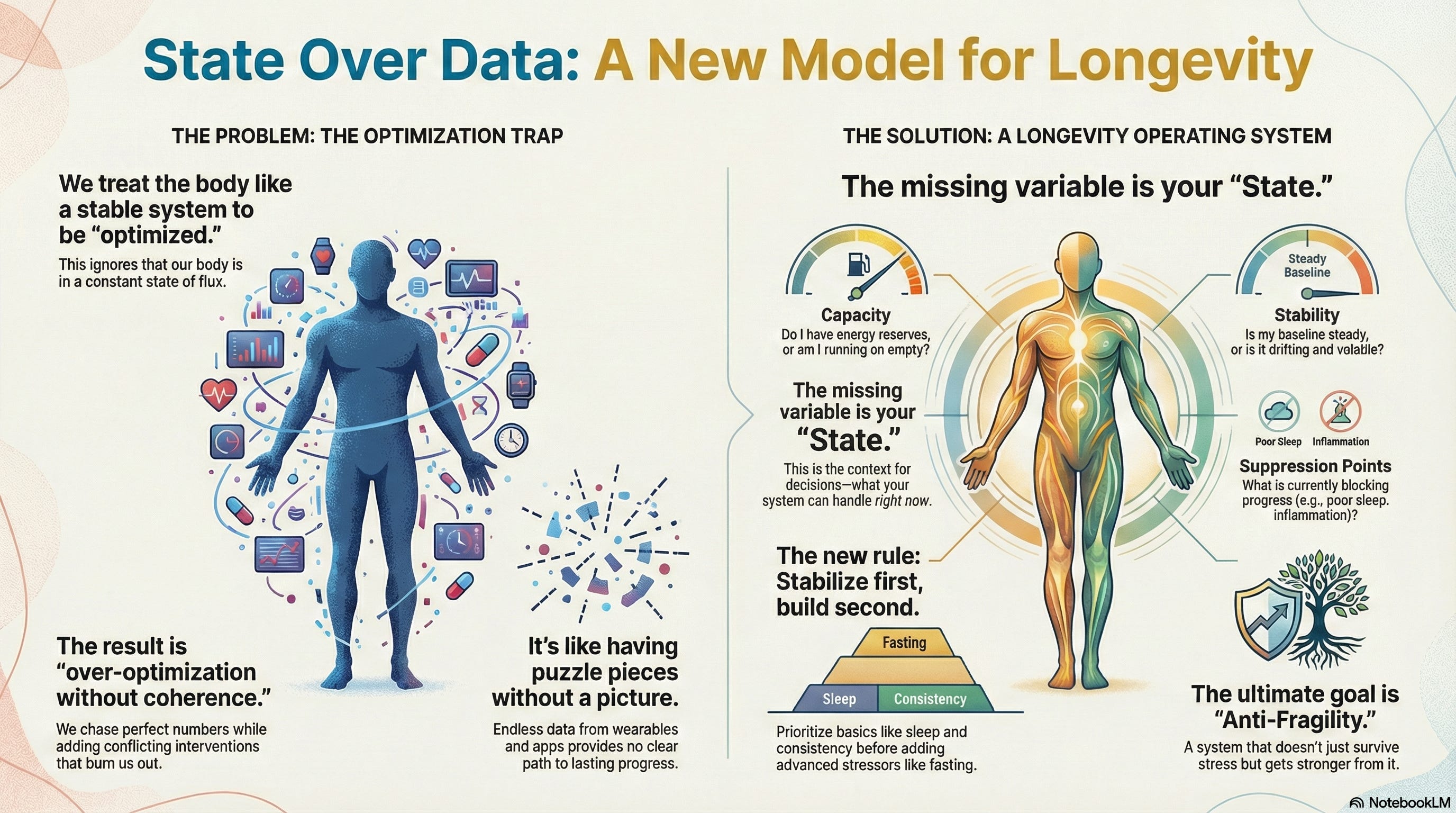
The week that finally made this concept click for me was surprisingly uneventful. It was just a normal week with a couple of late nights that I couldn’t avoid, travel that disrupted my routine, and work that spilled over into my personal time. Despite still doing all the “right things” like training, eating relatively healthy, and getting enough steps, the overall texture of my week had changed. I was getting less sleep, recovering more slowly, and my patience was wearing thin.
My data started to reflect this shift, telling a story of its own. My heart rate variability, or HRV, which measures the variation in time between each heartbeat, began to decline. My resting heart rate, which is normally a good indicator of my overall fitness level, started to creep up. My workouts felt heavier than usual, and I just didn’t feel like myself. It was a steady, gradual decline, rather than a dramatic crash.
At first, my old way of thinking kicked in, and I saw this decline as a challenge to be overcome. I thought that if I just tightened the screws and added more interventions, I could get back on track. So, I did what many people with high agency and discipline would do. I added more rules and tools to my routine. I started eating within a stricter time window, added a couple of fasted workout sessions, tried cold exposure to boost my discipline, and even added another supplement to my daily regimen. I also invested in another biohacking tool, because there’s always a new gadget or gizmo that promises to help us optimize our performance.
For a few days, this approach gave me the emotional payoff I was looking for - the feeling of being in control and taking charge of my health. But then, my body started to push back. I caught a mild bug, my training stalled, and I ended up feeling brittle, wired, and tired all at the same time. It was as if I was running on empty, but couldn’t seem to slow down. The whole experience started to feel less like a journey towards longevity and more like a part-time job that I was failing at.
That’s when it hit me, I didn’t need more inputs or interventions. What I needed was a way to understand what mode my body was in, and what choices made sense in that moment. It was like trying to navigate a complex terrain without a map. I needed a compass to guide me, not more tools to add to my backpack. This realization was a turning point for me, as I began to understand that true health and wellness is not just about adding more rules and rituals to our daily routine, but about tuning in to our own unique needs and rhythms.
The longevity industry has the same failure pattern
The world of longevity is divided into distinct tiers. At the high end, it’s a luxury affair, with concierge clinics, full-body MRIs, and genomics offering a glimpse into one’s biological age. These cutting-edge tools are often marketed as exclusive products, reserved for those with the means to afford them. Think of it like a high-end sports car, where every detail is meticulously crafted to provide an unparalleled experience.
Conventional healthcare sits at the other end. It tends to be overwhelmed and usually focuses on treating illnesses after they appear. This approach is reactive, rather than proactive. It’s like a firefighter tackling a blaze instead of taking steps to prevent it. Conventional healthcare is designed to address symptoms, not the underlying causes of a disease, which can lead to a cycle of treatment and relapse.
The majority of people, however, fall somewhere in between, navigating a complex landscape of wearables, biomarkers, apps, and podcasts. While these tools provide a wealth of information, they often lack cohesion, leaving individuals to decipher the data on their own. It’s akin to having a plethora of puzzle pieces, but no clear picture to guide the assembly. The result is a sense of measurement and effort, without lasting progress.
The missing link is orchestration. This method unites various elements to create a well-rounded longevity plan. Without it, individuals are left to navigate a confusing landscape, making it difficult to achieve meaningful results. Recognizing this gap helps us explore new ways to combine luxury healthcare, traditional medicine, and modern technology. This approach can lead to a more sustainable and effective route to longevity. This pattern of mistaking 'more' for 'better' isn't just my failing; it's endemic to the longevity industry itself.
The mistake I kept making (and I think the longevity market keeps making)
Most longevity thinking treats the body like it’s always in a stable baseline, and you’re just making small adjustments around the edges to achieve optimal health. Yet, this approach overlooks the complex and dynamic nature of the human body. The body isn’t stuck in one mode. It changes between different states. There are times of high energy, moments of overload and exhaustion, and phases of recovery and renewal. Also, travel, stress, and well-being can greatly affect how the body feels. Leading to stretches of time where you may feel fine but are actually brittle and vulnerable.
Real life is a sequence of these states, and your physiology is constantly adapting and renegotiating what it can tolerate. When you’re rested and full of energy, your body manages stress well. Yet, when you’re exhausted, even minor stress can seem overwhelming. This constant flux highlights the importance of considering the body’s dynamic state when making decisions about longevity and health.
Many people, myself included, often mistake longevity as just optimization. In reality, it’s about coordination. Optimization implies that there is one ideal state or set of circumstances that can be achieved through the right combination of interventions and strategies. Coordination acknowledges that the body is in constant flux. So, the same intervention can produce different effects depending on its current state. Fasting can be great when you’re stable and have enough resources. It sharpens your mind and enhances your health. But, if you’re depleted and stressed, it can backfire, fueling a fire that’s already burning. Cold exposure can feel refreshing when you’re well-rested and energized. But if your nervous system is already stressed, it might add to your burden.
The problem is not the tools or interventions themselves, but rather the sequencing and timing of their application. Too much training can boost strength and resilience, but it can also lead to injury. This shows why careful planning and attention to your body’s condition are so important. Understanding the body’s dynamic nature and the role of coordination allows us to craft more effective, personalized health approaches. These methods consider the complex interplay of factors that impact our well-being.
“State” is the missing variable
When I say “state,” I’m not talking about diagnosis. I mean decision context—what your system can absorb right now without paying for it later.
I’ve found it useful to think about state in three dimensions:
Capacity: do I have reserves, or am I compensating?
Stability: is my baseline steady or drifting (volatility counts)?
Suppression points: what's currently acting as the primary limiter – sleep deficit, unresolved pain, low-grade inflammation, unstable mood, glucose volatility?
Once you start looking through that lens, a lot of longevity confusion becomes obvious. The reason modern paradigms “work” and then suddenly “don’t” is often state mismatch.
Biohacker stacks work best when you’re stable. Metric optimization works when tracking doesn’t create anxiety and you have a steady baseline. Clinical medicine shines when there’s clear pathology. None of these approaches reliably tell you: what state are you in? What’s the next right move in that state?
What changed for me: stop stacking, start sequencing
I used to treat longevity like a menu. Pick enough good things, add them up, become healthier.
Now I treat it more like a control problem: what’s the smallest set of actions that restores coherence?
When I’m in a depleted, drifting state, “more” is usually the wrong answer. The right answer is often boring:
reduce training intensity before touching anything exotic
restore sleep timing and light exposure before chasing supplements
eat consistently before doing clever restriction
measure less, not more, if measurement is making me reactive
In other words: stabilize first. Build second.
And when I do build, I build in a way that doesn’t sabotage the other domains: sleep, mood, pain, metabolism. I’m trying to make the system cooperate, not win an argument with a readiness score.
That’s why I think longevity needs an operating system
An operating system doesn’t dump raw telemetry on you and call it “insight.” It detects state, manages tradeoffs, allocates resources, suppresses noise, and handles transitions.
That’s what longevity is missing: a control layer.
Not another dashboard. Not another protocol library. Not another clinic that you visit twice a year and hope connects the dots.
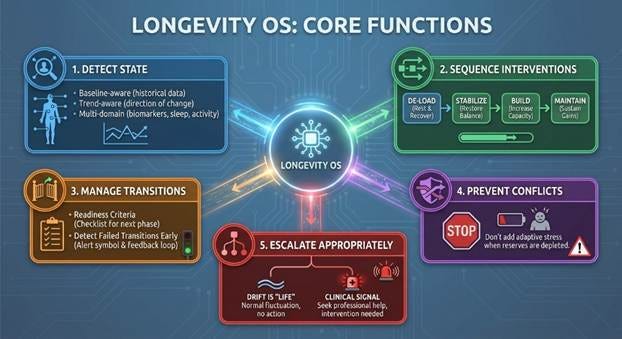
A longevity OS would do a few simple, but hard, things well:
Detect state (baseline-aware, trend-aware, multi-domain)
Sequence interventions (de-load → stabilize → build → maintain)
Manage transitions (readiness criteria; detect failed transitions early)
Prevent conflicts (don’t add adaptive stress when reserves are depleted)
Escalate appropriately (know when drift is “life” vs when it’s a clinical signal)
This isn’t an algorithm practicing medicine. It’s decision support. It stays conservative by default and clearly shows uncertainty. It aims to coordinate wearables, labs, clinicians, and coaching, not turn them into competing voices.
The real bottleneck is architecture.
The longevity market keeps failing in predictable ways:
Over-testing without context: results arrive without a decision frame—adaptation or drift?
Over-optimization without coherence: people chase perfect numbers while accumulating contradictory interventions.
Universal promises: protocols marketed as broadly beneficial, ignoring state and sequencing.
More data doesn’t fix this. It often amplifies it.
Architecture fixes it, because architecture forces coherence.
Once you see it as an architecture problem, a lot of debates in longevity get less emotional.
It’s not “data good” or “data bad.” It’s: where is the control layer that turns data into coherent action over time?
What I actually believe the “win” looks like
If longevity is working, it won’t feel like you’re always experimenting. You won’t be constantly searching for the right mix of training and recovery. You’ll experience fewer injuries when you avoid pushing your body too hard. This is important during times of overtraining or not getting enough rest. You’ll experience fewer metabolic crashes, where your body’s energy systems are depleted, leaving you feeling exhausted and drained. You’ll have fewer weeks where you feel overwhelmed. Instead of forcing yourself to be disciplined when you’re drained, you’ll avoid burnout and stay motivated.
With a well-functioning longevity approach, you’ll enjoy more stability and resilience, even during chaotic seasons of life, such as periods of high stress or significant change. You’ll have more capacity to handle challenges and adapt to new situations, making you better equipped to handle whatever life throws your way. Nassim Nicholas Taleb introduced the term “anti-fragility.” It describes a system’s ability to not just survive stress but to actually improve and gain strength from it. This is what longevity should aim for.
This sense of stability and resilience will also bring a sense of quiet and clarity to your daily life. You’ll have a short, prioritized list of tasks and activities that align with your goals and values, and a clear sense of what state you’re in, whether that’s a state of rest, recovery, or high-intensity training. You’ll also have permission to do less when less is the correct move, allowing you to conserve energy and avoid burnout. This concept resembles “wu-wei“ from ancient Chinese philosophy. It’s about aligning with life’s natural flow. You take action effortlessly, without strain or force.
More consistency through chaotic seasons. More capacity when it matters. More optionality later.
It will feel boring in the best way, like good infrastructure feels boring.
And that’s the point.
Longevity doesn’t need more data or complex metrics.
It needs an operating system: one that understands humans as complex adaptive systems. This system should help us stay coherent through changes and become “anti-fragile” in the process.