The Decision Weaver
Part I: The Hidden Skill Beneath Decisions

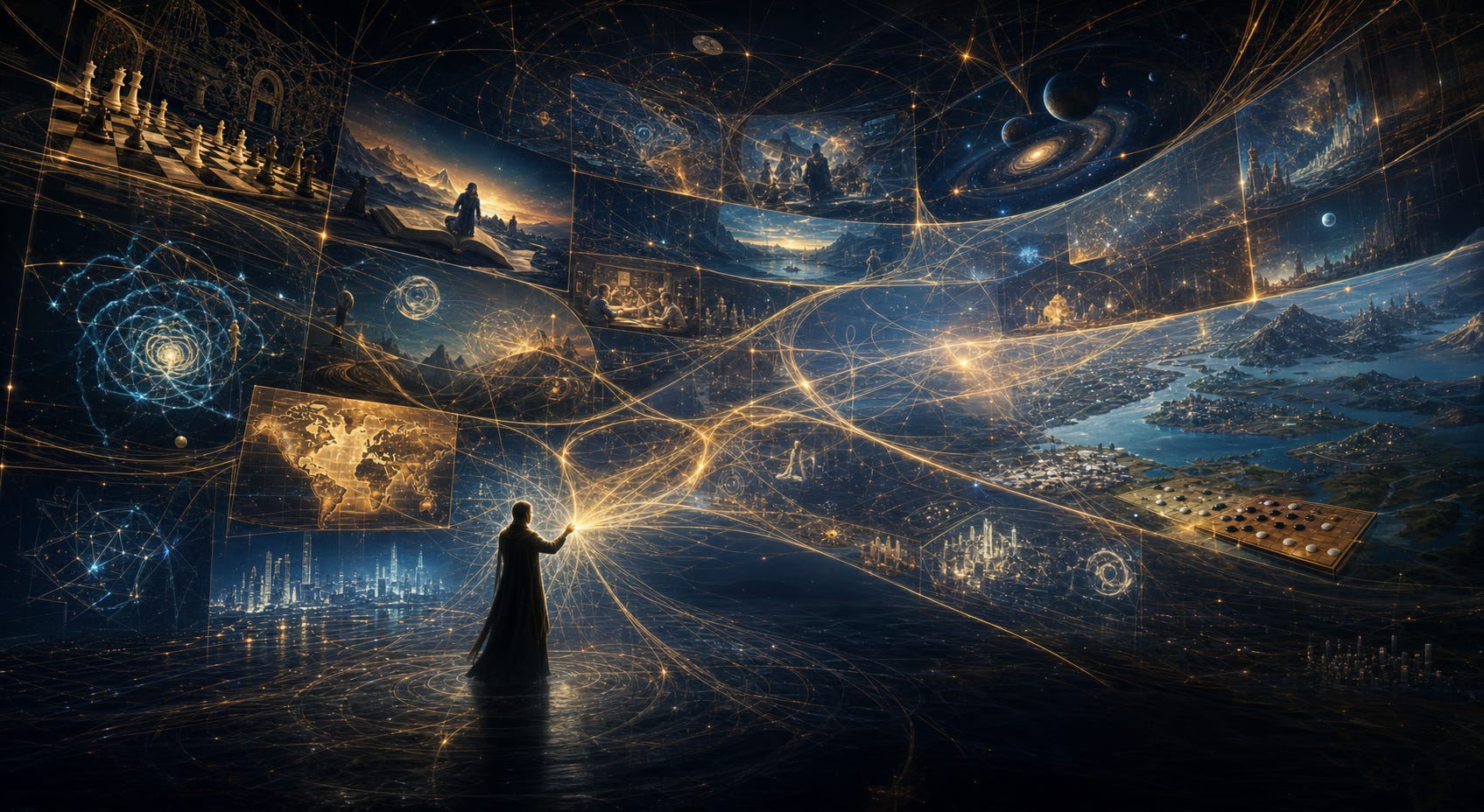
Executive Summary
Most people think decision-making is about choosing.
Choosing the right strategy. The right investment. The right technology. The right answer.
But what if decisions are not the starting point?
What if the quality of our decisions is constrained by something deeper: our ability to make sense of reality?
Children develop this capability through play. Games teach us to recognize patterns, navigate uncertainty, and understand the gap between where we are and where we want to be. Stories help us inherit ways of seeing from others. Experience refines those mental models over time.
Long before we become decision-makers, we become sense makers.
Yet modern life often focuses on answers while ignoring the process that produces them. We evaluate outcomes, but rarely examine the frames through which we interpret the world. We celebrate intelligence, but overlook orientation. We optimize decisions, while neglecting the sensemaking that shapes those decisions in the first place.
This essay introduces a simple but powerful idea:
Decision-making is downstream of sensemaking.
The ability to construct, test, revise, and share models of reality may be one of the most important skills of the twenty-first century. It underlies expertise, strategy, learning, leadership, and increasingly our relationship with artificial intelligence.
The future may belong not to those who have the best answers, but to those who can see more clearly, adapt more quickly, and navigate complexity more effectively.
In short:
Before every decision comes a way of seeing.
And learning how to see may be the most important decision of all.
Most people think decisions are about choosing.
Choose the right investment. Choose the right strategy. Choose the right technology. Choose the right career. Choose the right answer.
Entire industries have been built around helping us make better choices. Consultants, advisors, analysts, coaches, and now artificial intelligence systems all promise some version of the same thing:
Give us the problem, and we’ll help you find the answer.
It sounds reasonable. It is also incomplete.
Because before every decision comes something far more important: A way of seeing.
And long before we become decision-makers, we become sense makers.
Think about how children learn.
Before they can manage organizations, negotiate contracts, allocate capital, or build companies, they play.
They play tag. They play hide-and-seek. They play board games. They play strategy games. They invent stories. They imagine worlds.
For most of human history we have treated play as preparation for life. But preparation for what?
Researchers such as Peter Gray argue that play is one of humanity’s primary learning mechanisms is self-directed reality exploration. The common answer is that games teach skills: patience, strategy, discipline, cooperation, experimentation, consequences, and how to navigate uncertainty. Those things matter. But something deeper is happening.
Games teach us how to make sense of reality.
Games generally begin with a straightforward framework: a starting point and a destination. The difficulty lies in determining the path to take. From strategy games like chess and Go to sports like soccer and poker, players must continually assess the difference between where they are and where they want to be. This gap is what drives the game forward. As players navigate the game, they learn to perceive the gap, develop a plan to close it, and adjust to changing circumstances. The move itself is usually simple, it’s understanding the larger context that’s challenging. By teaching players to analyze their position, identify the gap, and adapt, games become powerful learning tools.
Dan Sullivan and Benjamin Hardy’s concept from The Gap and the Gain offers a valuable insight. Most people assess themselves by comparing their current situation to a perfect future. This focus on the gap between where they are and where they want to be leads to frustration. In contrast, experts compare their current situation to their past, focusing on the progress they’ve made, known as the gain. This shift in perspective leads to growth and momentum. The circumstances remain the same, but the interpretation changes. The quality of our decisions depends on our ability to make sense of things.
Games like chess, poker, bridge, and Go teach us to see patterns, make decisions with uncertainty, and think in terms of systems. These games train players to understand situations before acting. Top investors, entrepreneurs, and strategists often play games because they improve sensemaking skills. Warren Buffett’s interest in bridge and Annie Duke’s insights from poker demonstrate how games can help people handle uncertainty and adjust their assumptions. Games teach people to update their beliefs and recognize when their understanding of reality is no longer working. They train people to make better decisions by improving their sensemaking abilities.
Modern games reinforce the lesson. As Jane McGonigal has shown, games function as resilience engines and futures simulators. Every action is an experiment. Every failure becomes feedback. Every success updates the model. Games compress experience. They create a safe laboratory for testing mental models before the real world charges us full price.
Stories perform a similar function.
A child listens to a story and learns how actions create consequences. Who can be trusted. What matters. What doesn’t. What causes success. What causes failure.
Stories do not merely entertain. Stories teach us how to interpret reality. They are compressed sensemaking.
A story is not simply information. A story is a frame. One person’s experience condensed into a form another mind can absorb.
Civilization itself may depend on this capability. We inherit ways of seeing through the stories we tell.
Games train sensemaking. Stories transfer sensemaking. Experience refines sensemaking.
Yet remarkably few people ever learn to recognize sensemaking as a distinct skill. Instead we focus on decisions. On outcomes. On answers. On actions.
We study what people choose. We rarely study how they learned to see.
And that may be a mistake.
Because the quality of your decisions is constrained by the quality of your sensemaking. Sensemaking is not passive observation of reality; it is an active construction. We do not merely adopt a frame—we weave it, pulling threads of data, experience, narrative, and experimentation into a coherent tapestry. If the threads are flawed, the fabric fails.
Consider a simple example.
A CFO, an HR director, and a product manager walk into the same struggling organization.
The CFO sees a margin problem. The HR director sees a retention problem. The product manager sees a market-fit problem.
Each gathers evidence. Each builds arguments. Each develops recommendations. Each can point to data supporting their conclusions.
Yet they arrive at entirely different answers.
Why?
Most people assume they interpreted the data differently. But often something deeper occurred. They were operating from different frames. And those frames determined what counted as meaningful data in the first place.
The frame came first. The data came second.
This pattern repeats throughout history. When digital photography emerged, Kodak’s executives saw only a threat to their film business. A different frame might have revealed an opportunity to dominate a new medium. They had the technology. They lacked the right frame.
This becomes increasingly important in a world of growing complexity.
Many of humanity’s most important challenges are no longer puzzles. Healthcare is not a puzzle. Geopolitics is not a puzzle. Organizational transformation is not a puzzle. Artificial intelligence is not a puzzle. Building a meaningful life is certainly not a puzzle.
These are living systems. Puzzles have defined edges and static pieces; you solve them and they stay solved. Living systems breathe, adapt, and react to your every intervention. Every solution creates new consequences. Every answer generates new questions.
In such environments, choosing correctly is often less important than understanding what kind of situation you are actually facing. The challenge is no longer decision-making alone. The challenge is orientation.
This is where many intelligent people struggle.
Intelligence often helps us optimize within a frame. It does not automatically help us question the frame itself.
A brilliant executive can maximize the wrong metric. A brilliant engineer can solve the wrong problem. A brilliant strategist can optimize the wrong objective. A brilliant AI can generate flawless answers to the wrong question.
The issue is not intelligence. The issue is frame fixation. The inability to recognize that the way we see reality may itself be incomplete.
The best decision-makers seem to understand something different.
They spend surprisingly little time asking: “What is the answer?”
Instead, they ask: “What is happening?” “What am I missing?” “What assumptions am I making?” “What frame am I trapped inside?” “What would this look like from another perspective?”
These questions often feel inefficient. They delay action. They create ambiguity.
But they also create the possibility of seeing something new. In complex environments, “wicked problems,” or periods of high uncertainty seeing clearly is often more valuable than acting quickly.
The more I study expertise, strategy, decision-making, and increasingly artificial intelligence, the more I return to the same conclusion:
Decision-making is downstream of sensemaking.
Children develop it through play. Cultures transmit it through stories. Experts refine it through experience. Games accelerate it through simulation. AI may one day amplify it through co-intelligence.
Before every action comes orientation. Before every answer comes interpretation. Before every decision comes a way of seeing.
Which leads to a strange realization.
The most important decision you make is rarely the decision itself. It is deciding how to look and having the skill to weave a new frame when the old one fails.
This essay is the first in a series exploring a simple but increasingly important question:
How do people learn to navigate complexity, uncertainty, and change?
Along the way we will explore expertise, games, stories, strategy, artificial intelligence, and the hidden architectures behind human judgment.
Because beneath all of them lies a common capability: The ability to construct, test, revise, and share models of reality.
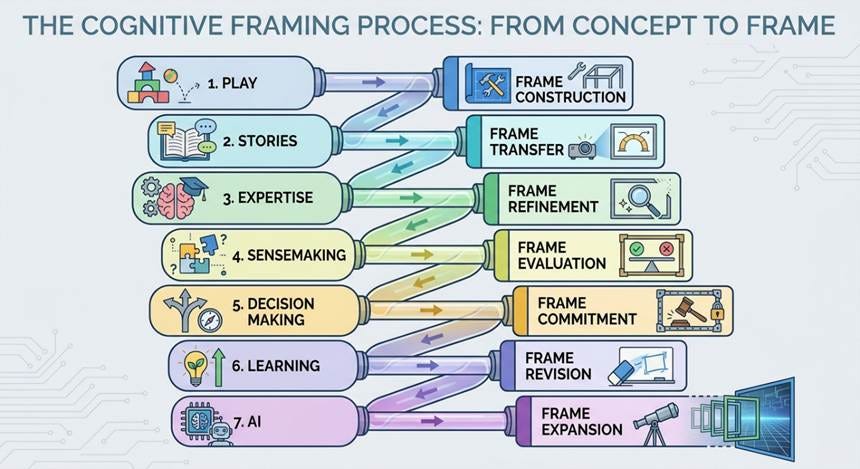
The people who master that process become something more than decision-makers. They become decision weavers.
And in a world of increasing complexity, that may be one of the most valuable skills of all.
What frames are you currently trapped inside?
Next: How Experts Sense make — What firefighters, military commanders, investors, surgeons, and master operators can teach us about seeing what others miss.