The Scarcity After Intelligence
Part II: Selection in an Age of Abundance

Executive Summary
Artificial intelligence is often described as a technology that will make intelligence abundant.
If that proves true, then the defining question of the next decade may no longer be How do we create more intelligence?
It may become:
What becomes valuable once intelligence is no longer scarce?
This essay argues that abundance changes more than economics. It changes the environment itself.
History suggests that every great infrastructure transition—from electricity to computation—reshaped the conditions under which people, organizations, and civilizations competed and collaborated. Artificial intelligence may represent the next such transition.
When environments change, the fundamental issue is no longer scarcity.
It is selection.
The capabilities that once created advantage may become commonplace. New forms of value emerge. New organizational models appear. New ways of discovering, coordinating, and creating become possible. Success increasingly belongs not to those who possess the most intelligence, but to those capable of adapting while preserving coherence across changing conditions.
The future may therefore be defined less by an abundance of intelligence than by a scarcity of adaptive capacity.
That realization leads naturally to an even deeper question.
What allows some adaptive systems to transform while remaining themselves, while others lose coherence and disappear?
Editor’s Note
This is the second essay in a three-part series exploring what happens when intelligence becomes infrastructure.
In Part I, I argued that AI may be following the same historical path as electricity and computation—not simply becoming cheaper, but becoming a foundational infrastructure layer capable of reorganizing entire economies and societies.
If that is true, then a new question naturally follows.
If intelligence becomes abundant...
...what becomes scarce?
This essay argues that scarcity is only part of the answer.
The deeper story is selection.
We Have Asked the Wrong Economic Question
Whenever a technology becomes dramatically cheaper, economists naturally ask:
“What happens to price?”
Investors ask:
“Who captures the value?”
Workers ask:
“What happens to my job?”
These are reasonable questions.
But history suggests they are incomplete.
The arrival of electricity did not simply lower the cost of power.
It reorganized industrial civilization.
The arrival of computation did not simply lower the cost of calculation.
It reorganized finance, communication, manufacturing, entertainment, science, education, and eventually everyday life.
Every major infrastructure technology changes the environment in which everything else operates.
Once the environment changes...
selection begins.
Two Different Worlds
Two Different Worlds
One realization changed how I think about economics.
Scarcity and abundance are not simply different market conditions.
They are different worlds.
And each rewards a different kind of intelligence.
Scarcity Intelligence
Scarcity asks:
How do we allocate?
How do we optimize?
How do we prioritize?
How do we reduce waste?
How do we compete?
This is the intelligence of logistics. Supply chains. Budgets. Scheduling. Forecasting. Optimization. Prediction.
For centuries this has been the dominant intelligence of business.
It is extraordinarily powerful.
But it is not the only kind of intelligence.
Abundance Intelligence
Abundance asks different questions.
What new combinations become possible?
What haven’t we explored?
What can now exist that couldn’t before?
How do we discover rather than merely optimize?
This is not an optimization mindset.
It is an exploration mindset.
The distinction sounds subtle. It isn’t.
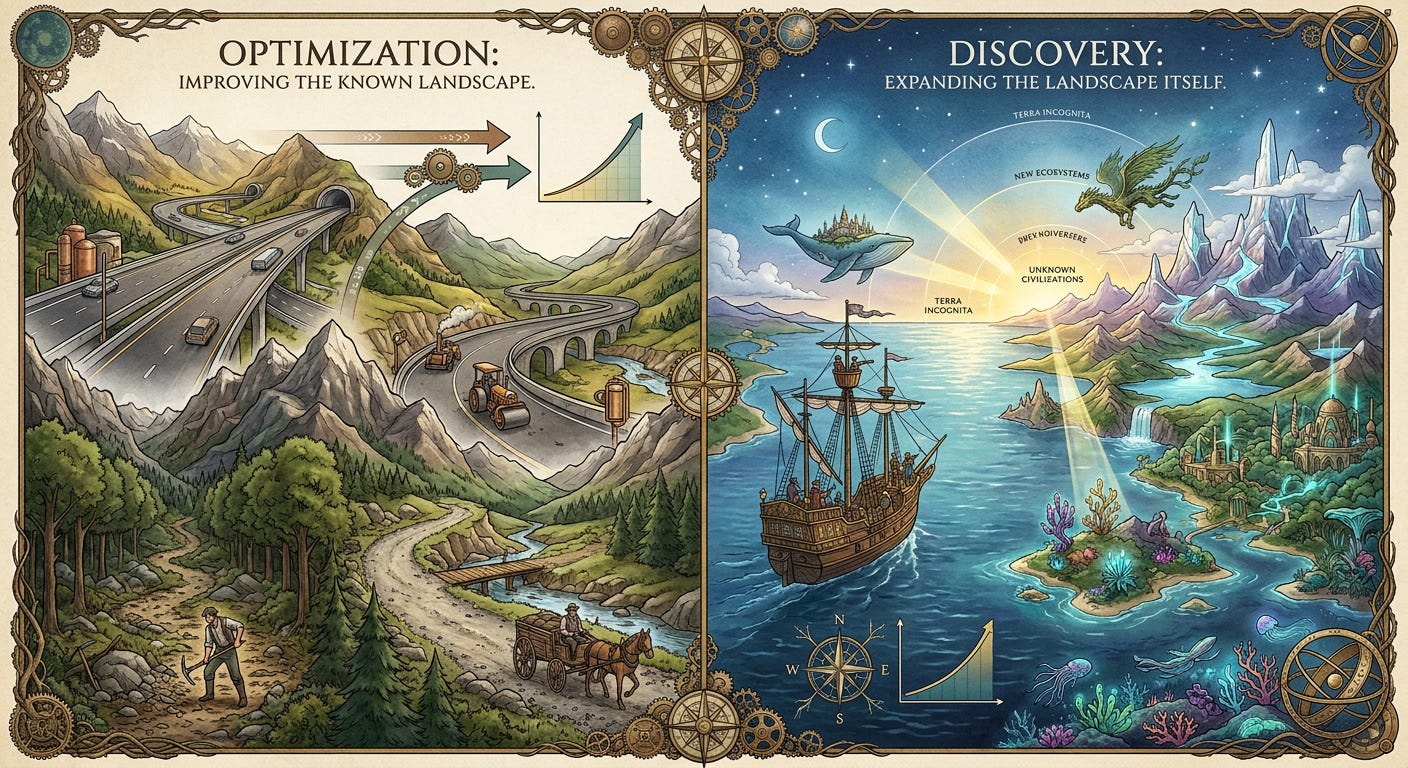
Optimization improves the known world.
Discovery expands it.
One kind of thinking navigates. It moves through possibility spaces that already exist, finding the best path through known terrain. It is extraordinarily powerful within that terrain. But it cannot see outside it.
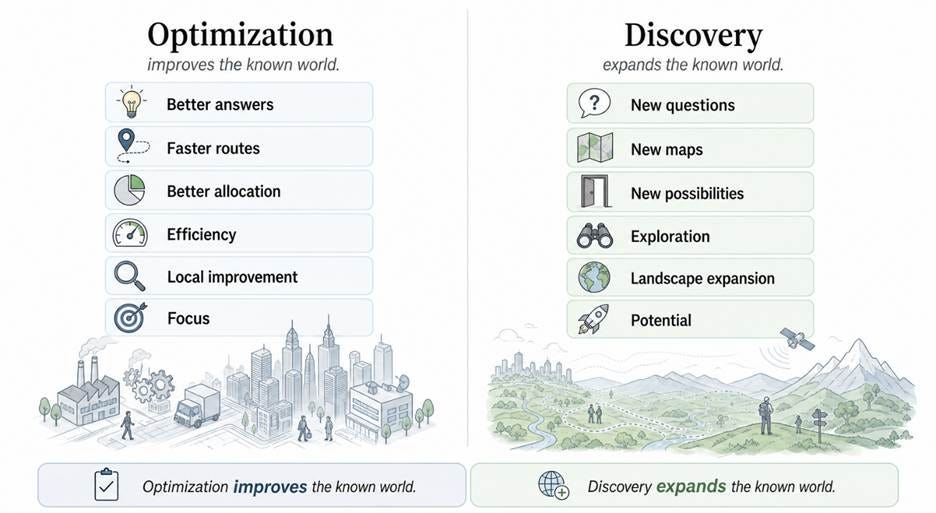
The other kind of thinking explores. It keeps asking why past the point of comfort. Past the point where a reasonable person would stop. Past the point where the answer feels close enough. This is not inefficiency. It is how hidden terrain gets found.
Here is what makes this matter now.
For most of history, navigating dominated because exploring was expensive. Sitting with confusion long enough to find genuinely new ground required rare human capacity: time, tolerance for uncertainty, the willingness to look foolish before looking right.
When intelligence becomes infrastructure, that equation inverts.
Navigation gets cheap. Exploration becomes the scarce thing. Not because it gets harder. Because everything around it gets easier.
This is the hidden logic of selection in an intelligence-rich world. The environment doesn’t just reward more intelligence. It changes which kind of intelligence matters.
Discovery Becomes Infrastructure
Imagine walking into a library.
Navigation helps you find the right book faster.
Discovery builds entirely new wings onto the library.
Civilizations have historically been constrained not only by what they know, but by how quickly they can discover what they don’t know.
One of my favorite examples comes from chemistry.
In 2025, researchers at the Institute for Basic Science in South Korea built autonomous robotic laboratories capable of exploring enormous chemical possibility spaces through thousands of experiments under varying conditions. Instead of asking whether a single reaction worked, they asked a much larger question: what does the landscape itself look like?
The result surprised even experienced chemists.
What the robots found wasn’t just surprising. It was structurally important.
Reactions that chemists had studied for over a century turned out to be hiding entire networks of unseen products and behaviors. Not because the chemistry was wrong. Because the exploration had always followed the same well-worn paths. The robots called this the DarkNet of chemical reactivity: patterns that were always there, invisible only because no one had looked systematically enough to find them.
This is not a chemistry story. It is a story about the nature of knowledge itself.
We have always explored the world the way a traveler follows roads. Careful. Purposeful. Moving from known point to known point. The roads are real and the destinations matter. But roads only show you what roads show you. The terrain between them remains unmapped.
What is now becoming possible is a second kind of exploration entirely. Not following roads more efficiently. Mapping the terrain itself.
These are not competing approaches. They are two different engines of discovery, and they feed each other. Focused exploration reveals promising regions worth mapping systematically. Systematic mapping reveals unexpected terrain worth exploring in depth. The chemistry breakthrough is a perfect example: the robots found hidden reaction networks that now demand focused human investigation, while also opening entirely new territories no one knew to pursue.
For centuries, knowledge grew one road at a time. What changes when we can map the territory between them?
That question does not have a comfortable answer. Because if the DarkNet of chemistry was hiding in reactions studied for a hundred years, the same is almost certainly true in biology, in medicine, in economics, in materials science. In every domain where we have been following roads and calling it understanding.
The landscape of possible knowledge is far larger than the map we have drawn so far.
Selection Is the Hidden Engine
This is where biology becomes a surprisingly useful teacher.
When oxygen increased hundreds of millions of years ago, life did not simply become better.
The environment changed.
New ecological niches appeared.
Eyes evolved.
Predators emerged.
Armor appeared.
New body plans were tested.
Most disappeared.
Some survived.
The important observation is this:
Evolution did not reward intelligence.
It selected for organisms capable of thriving within a new environment.
History tells remarkably similar stories.
The printing press selected for literate societies.
Industrialization selected for electrified factories.
The internet selected for network-native organizations.
Artificial intelligence may select for something different again.
What Is Being Selected?
Most people asking this question are looking in the right direction but at the wrong thing.
They see intelligence becoming abundant and conclude that what becomes scarce is the human touch. Authenticity. Presence. Warmth. The things machines cannot replicate.
This is partly true. But it is not the deepest answer.
Others conclude that what becomes scarce is position. The ability to sit at the right node in a newly emerging architecture and orchestrate the intelligence flowing through it. This is also partly true. But it still isn’t the deepest answer.
Here is what the chess program AlphaZero reveals that neither answer captures.
In 2017, AlphaZero learned five centuries of human chess theory in four hours. It played in ways grandmasters described with visible unease as nothing human. And yet the chess community trusted it almost immediately. Not because it felt familiar. Not because it occupied a powerful position. But because you could follow what it was doing. You could watch its commitments unfold over a game and understand what it was trying to accomplish, even when you had no idea how it was thinking.
This is the selection pressure that most discussions miss.
In a world of abundant intelligence, what gets selected for is not raw capability. It is not warmth or familiarity either. What gets selected for is the ability to remain readable and trustworthy while operating in genuinely new territory.
Four things determine whether a system earns that trust. How it thinks under the hood. Whether its behavior is easy to follow over time. Whether its goals stay compatible with the people depending on it. And whether it feels familiar enough to work with.
The mistake most organizations make is assuming these four things move together. That a system which feels trustworthy is trustworthy. That familiarity signals alignment. That comfort means safety.
AlphaZero proved otherwise. How it thought was completely alien. It felt nothing like a human chess player. But you could track its decisions and verify its results. That was enough.
Selection in an intelligence-rich environment does not reward the most intelligent system in the room. It rewards the system that can operate at the edge of the known while remaining connected to the people and purposes it serves.
That capacity has a name.
The Real Scarcity
For a long time I believed intelligence would remain the defining scarce resource.
I’m no longer convinced.
The deeper scarcity may be adaptive coherence. The ability to remain recognizably yourself while continuously changing.
But naming it is easier than understanding why it is so hard.
Consider what happened to the Atlantic cod fishery.
For centuries, the Grand Banks off Newfoundland were the most productive fishing grounds on earth. The cod seemed inexhaustible. Entire coastal civilizations built themselves around that assumption. Then industrial trawling arrived. Bigger boats. Better sonar. Nets that could sweep the ocean floor clean.
By every fast measure, the fishery was thriving. Catches were up. Technology was improving. The industry was optimizing brilliantly. What no one was reading carefully enough were the slow signals. Spawning populations quietly collapsing beneath the surface. Recovery timescales measured in decades, not seasons. The ocean floor, scraped repeatedly, losing the structural complexity that juvenile cod needed to survive.
In 1992, the Canadian government declared a moratorium. Two centuries of continuous fishing ended in a single announcement. Thirty thousand people lost their livelihoods almost overnight.
The cod have not recovered. Thirty years later, the population remains a fraction of what it was. The slow field did not send a warning. It sent a wall.
This is the pattern beneath most coherence failures. It is rarely a failure of intelligence or intention. The fishermen were skilled. The scientists were watching. The government had data. What failed was the ability to let slow signals carry enough weight to constrain fast ones. The pressure to keep fishing, this season, this quarter, this year, was immediate and concrete. The pressure from the collapsing population was distant and abstract until it wasn’t.
Fast moving systems, whether fishing fleets, companies, or algorithms, tend to outrun the slower fields they depend on. Markets depend on trust, which builds slowly and breaks quickly. Organizations depend on culture, which changes over years not quarters. Ecosystems depend on stability that operates on timescales no business cycle captures.
When fast systems stop listening to slow signals, they do not collapse immediately. They drift. The drift is invisible for a long time because everything still appears to be working. Catches are up. Revenue is growing. The models are improving.
Then the slow field sends its final signal. And it does not arrive as a warning. It arrives as a wall.
This is why adaptive coherence is the real scarcity. Not the ability to change. Most systems can change when forced to. The scarce thing is the ability to stay sensitive to slow signals while operating under the pressure of fast ones. To let what is coming inform what you are doing now, before the gap between them becomes unbridgeable.
The systems that survive periods of transformation are not the ones that move fastest. They are the ones that never lose the thread back to reality.
The Architecture of Survival
This idea isn’t new. Life has been solving this problem for billions of years. And the solution it found is worth understanding carefully, because it is not what most people expect.
Life does not maintain coherence through rigidity. It maintains coherence through layers.
This is not a framework I invented. It comes from the biologists Eva Jablonka and Marion Lamb, whose book Evolution in Four Dimensions spent decades making the case that biological inheritance is far richer than the standard genetic story suggests. What they found, and what the evidence has continued to support, is that living systems pass information across generations through not one channel but four. Each operating at a different speed. Each encoding a different kind of knowledge.
The deepest layer is the slowest. Genetic information changes across generations, preserving what has worked across vast stretches of time. It is the long memory of the system. The thing that says: this is what we are.
Above that sits a faster layer. Epigenetic patterns can shift within a single lifetime in response to environment and experience. The organism does not have to wait for evolution. It can adjust how its genes express themselves based on what is actually happening around it. This is the layer that says: this is what we are becoming.
Above that, behavior. Animals learn within their own lifetimes, passing successful strategies to offspring through observation and imitation. Knowledge that would take generations to encode genetically can spread through a population in a single season. This layer says: this is what works here, now.
And above that, in humans alone, culture. Language, institutions, stories, tools. The accumulated intelligence of generations made available to individuals who never had to earn it through experience. This layer moves fastest of all, and carries the most information. It says: this is what we have learned together.
Four layers. Four different speeds. Each one preserving something the others cannot. Each one changing at the pace that its kind of information requires.
No single layer could do what all four do together. A system that only preserved would fossilize. A system that only adapted would have no identity to adapt from. The coherence of living systems comes not from any single layer but from the tension between all of them, slow anchoring fast, fast informing slow, each checking the drift of the others.
This is the architecture that has kept life viable through five mass extinctions and four billion years of changing environments.
It is not a metaphor for what organizations and civilizations need to build. It is the proof of concept.
Perhaps intelligence has always been less about prediction and more about maintaining this kind of layered tension. Staying coherent across timescales while the world keeps changing underneath you.
Looking Ahead
Every great infrastructure transition eventually becomes a test.
Not of technology.
Of adaptation.
Artificial intelligence may soon make intelligence abundant.
Discovery may become abundant.
Possibility itself may become abundant.
The real question is no longer whether we can build more intelligence.
It is whether we can build people, organizations, institutions, and perhaps even future AI systems, that remain coherent while navigating a world where the space of possibilities expands faster than our ability to comprehend it.
That, I suspect, is the real scarcity.
And it points toward the deepest question of all.
Why do some adaptive systems successfully transform while others disintegrate?
That is where we turn in the final essay:
The Geometry of Survival.
Recommended Reading
Infrastructure & the Economics of Abundance
Frank Diana — AI May Be Two Engines at Once (essay)
Sangeet Paul Choudary — The Jevons Misunderstanding (essay, on why falling costs increase rather than decrease total consumption)
Steven Waterhouse — The AI-Enhanced Operator (essay)
Alex Imas — Ghosts of Electricity (essay, on trust and human presence in an automated economy)
William Darity Jr. — writings on alternatives to the scarcity principle in economics
Biology, Inheritance, and Adaptive Coherence
Eva Jablonka & Marion J. Lamb — Evolution in Four Dimensions: Genetic, Epigenetic, Behavioral, and Symbolic Variation in the History of Life (MIT Press). The source of the four-layer inheritance model underlying this essay’s argument on coherence across timescales.
Michael Levin — research on bioelectric signaling, morphogenesis, and cognition distributed across non-neural tissue. Start with his lab’s publications at Tufts University or his talks on “the space of possible minds.”
Systematic Discovery
Institute for Basic Science (South Korea) — published research (2025) on robotic high-throughput mapping of chemical reaction networks, the source of the “DarkNet of chemical reactivity” finding referenced here.
Francis Bacon — Novum Organum (1620), the original case for systematic experimentation as a complement to pure reasoning, referenced here through the “Third Organon” framing of discovery-driven science.
Trust, Legibility, and Machine Cognition
DeepMind — research papers on AlphaZero (2017–2018), particularly Mastering Chess and Shogi by Self-Play with a General Reinforcement Learning Algorithm. The chess community’s reaction is documented extensively in contemporaneous grandmaster commentary, including Garry Kasparov’s public analysis.
The cod fishery example is an exact example of what I talk about when I say markets that don't collapse, they empty. Everything might look fine on the surface, right up until the slow signal comes as a wall instead of a warning. I think that's actually the same point you're making about coherence, too; the fishery lost the ability to let the slow signal constrain the fast one. I know you frame selection as environmental, almost neutral, like rising oxygen, but someone built the incentive structure that made fast signals dominate slow ones. I don't think cod got selected by nature alone. I think the incentive structure was designed. Appreciate the tag, LaSalle! Great thoughts here.