The Viability Problem
Why intelligence isn't enough — and what systems that endure actually require

Executive Summary
Three writers, working independently in economics, ecology, and civic finance, each described the same hidden pattern: systems stay healthy when their resources keep moving, and grow fragile when those resources pool up and stop. Read together, their essays point to a single principle that reaches far beyond money or forests.
This piece proposes a simple way to capture it:
System Health = (Stocks × Flows × Regeneration) ÷ Burden
The argument has one counterintuitive core. We obsess over the top of that equation — what a system has, how much it makes, how fast it grows. But the deciding factor usually lives in the denominator: Burden, the silent, compounding cost of holding together everything that no longer fits. Because burden divides into a system’s health rather than subtracting from it, it can stay invisible behind healthy-looking numbers right up until the system suddenly tips over.
This reframing carries a second implication: that intelligence itself is best understood as compatibility management — the continuous work of reconciling incompatible demands, which is why every capable system, from a kitchen line to an AI, keeps growing new layers to handle the mismatches it encounters. And its highest form isn’t reconciliation within fixed rules, but the move to enlarge the system until the old contradictions dissolve.
We have spent a century learning to measure the numerator. This series asks what it would mean to measure the denominator — and why that may be the most important question in understanding why any complex system thrives or falls apart.
Three essays landed in front of me over the span of a couple of weeks. They had nothing to do with each other, or so I thought. One was about the circulation of capital. One was about rainforests. One was about why ordinary American families feel like they’re drowning. Different writers, different worlds, no obvious connection.
I wasn’t looking for a connection. I was just reading. In the middle of the second one, I felt something strange. It was like when three people describe different animals, but you realize they’re all talking about parts of the same elephant.
Let me show you the three pieces, the way they arrived.
The first one was about money that forgot how to move.
Quy Ma — a writer who had been thinking about money, specifically about how fast it moves and where. His argument went like this. There are really two kinds of money in an economy. Money works when it flows through paychecks, businesses, tools, and production. It involves the actual making and doing of things. And then there’s money that just sits and appreciates, parked in things that go up in value all by themselves while you wait.
Over the last forty years, the way we set up the rules quietly rewarded the second kind and punished the first. Money that moved through work got taxed. Money that sat still in appreciating assets got rewarded. So, being money, it learned the lesson and stopped moving.
The country didn’t get poorer. On paper it got richer. But the wealth pooled up in places where it stopped touching ordinary life. His point was simple and a little haunting: the wealth is still here. It just stopped circulating. (His proposed fix is a tax that rewards capital for actually being put to work. The fix isn’t what grabbed me. The diagnosis was.)
I filed it away. Interesting. Then I read the rainforest one.
The second one was about dirt.
Specifically, the dirt under the Amazon. Here’s a fact I genuinely did not know: the most lush, abundant, life-packed forest on the planet grows out of some of the poorest soil on Earth. Early settlers cleared the rainforest expecting to find rich farmland underneath. They found the opposite — thin, acidic, nutrient-starved dirt.[1]
It makes no sense at first. How do you get the richest ecosystem on Earth out of the poorest soil?
Ryan Lynch‘s answer: the forest doesn’t store its wealth. It keeps its wealth moving. A leaf falls, it rots, fungi grab the nutrients and hand them off, something eats it, something breaks that down, around and around, endlessly. The nutrients almost never sit still. The forest is rich not because it has a lot saved up, but because nothing ever stops circulating.
That line made me sit up: he pointed out that if circulation ever breaks. If nutrients start pooling in just a few dominant trees instead of flowing back out. The forest won’t get stronger. It gets more fragile.
Wait. I had just read that exact sentence. About money.
The third one was about feeling heavy.
Debbie Resnick‘s piece wasn’t academic at all. Regular Americans feel exhausted. They work harder but often fall behind. They carry a weight that doesn’t match their effort. Her claim was that the heaviness isn’t a personal failing or even mainly a political problem. It’s structural. This burden weighs down the world ordinary people live in—the paychecks, small businesses, and daily grind. While an enormous, faster financial world moves right alongside it, barely taxed, barely touching the ground people actually walk on.
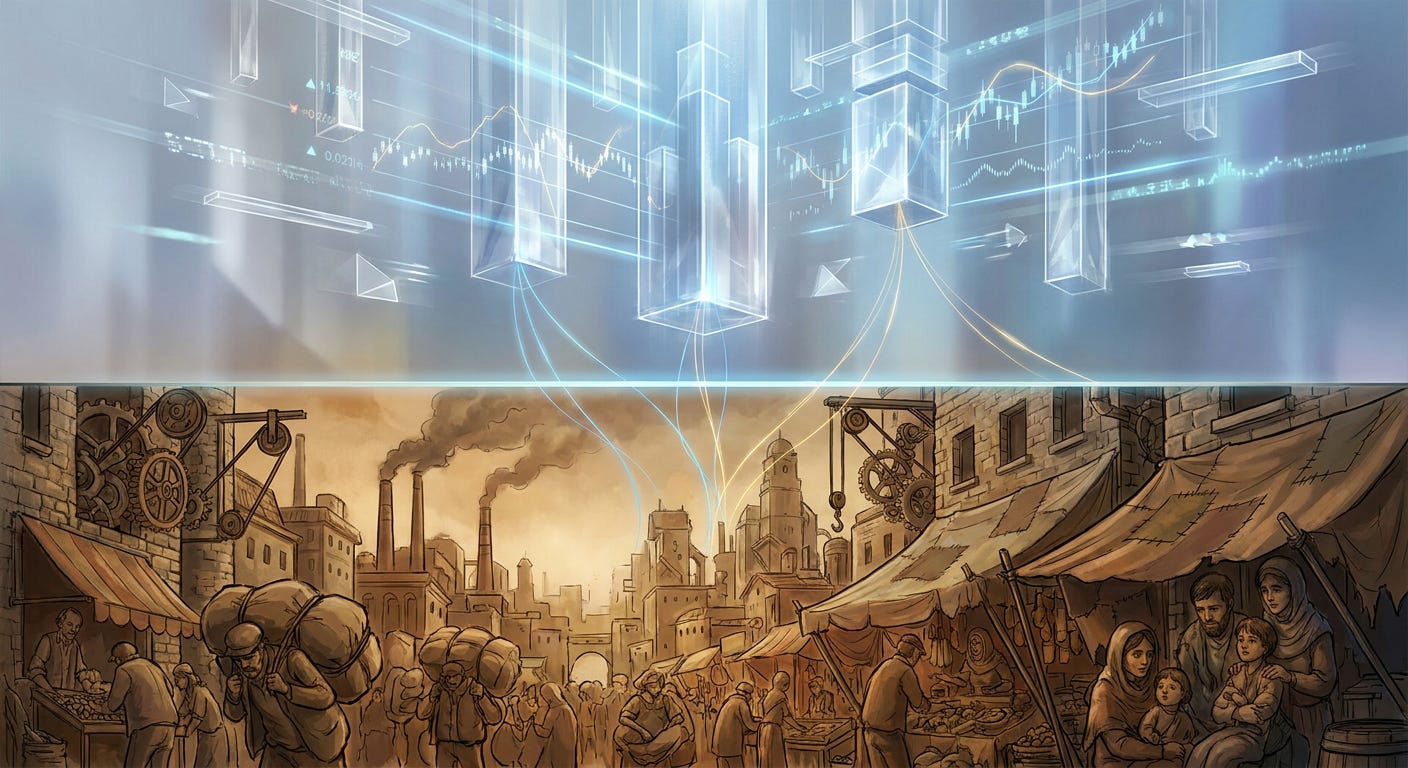
Two economies, sharing one country. One slow and heavy, carrying everyone. One fast and weightless, floating above.
And that’s when the shape showed up.
Three writers. Taxes, dirt, exhaustion. None of them setting out to make the same point. And every single one of them was describing the same thing:
A system stays healthy when its resources keep moving. It gets sick when they pool up and stop.
Lynch understood it best. Nature has been conducting this experiment for millions of years. It doesn’t have a political party to protect.
Now, I want to be honest. Noticing that three essays rhyme is not exactly a breakthrough. People see patterns everywhere, and most of them are noise. So I tried to break it. I poked at it for weeks. And it kept refusing to fall apart. Worse, every time I pushed on it, it got bigger.
Let me try to show you why.
Here’s something I only understood in hindsight. These three ideas didn’t reach me in isolation. Quy Ma had written his piece about money. Later, he encountered Resnick’s argument, which approached the same issue differently. Around that time, he also found Lynch’s rainforest essay and shared it. That’s how it reached me. By the time I read all three, the ideas were already mid-collision, already clicking into each other across three different minds. I didn’t invent the connection. I just happened to be standing where I could see it forming.
Howard Bloom once said that ideas are like living organisms. They move through an intellectual ecosystem, bumping into one another. They seek compatible structures to latch onto and transform into something new. Most never find a match and quietly die off. But every so often two of them fit together and produce something neither one contained alone.
That is exactly what happened here. Three writers each hold a valuable piece of work, but each piece is locked in its own little room. The only reason the rooms connect is that the ideas drifted into the same space at the same time and clicked perfectly.
And once you’ve watched ideas do that — find each other, fit, and make something new — you start to wonder if that fitting is the whole secret. Not just for ideas. For everything.
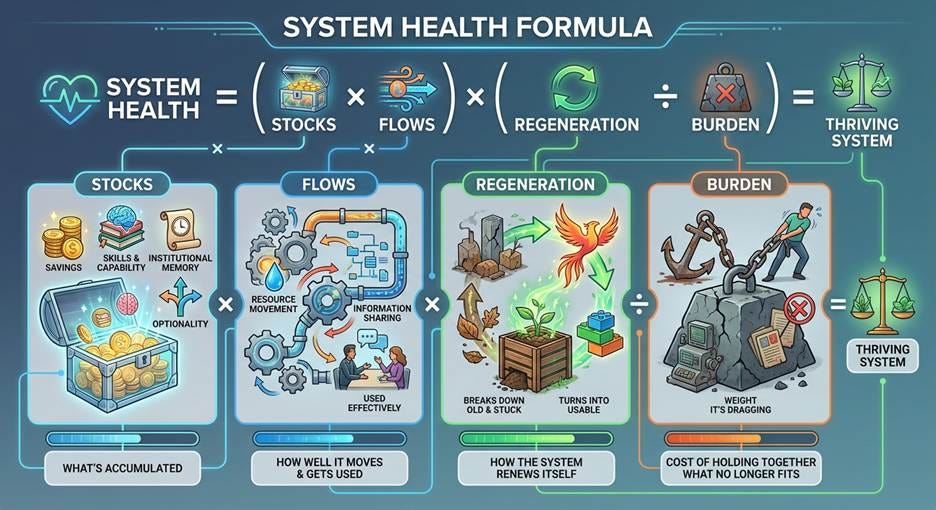
So here’s the little formula I’ve been carrying around ever since. Don’t let the fact that it’s written like an equation worry you. It’s really just four plain ideas stacked together:
Health ≈ (what you have × how well it flows × how well it renews) ÷ what’s weighing it down
And here’s the same thing in slightly more precise language, for anyone who wants to actually use it as a tool:
System Health = Stocks × Flows × Regeneration
Burden
Let me take the four pieces one at a time, in plain words.
What you have. Your savings. A forest’s nutrients. A company’s skilled people. A country’s factories and know-how. The stuff that’s piled up. Easy enough.
How well it flows. Whether that stuff actually moves and gets used, or just sits in a heap. The money that circulates. The nutrients that cycle. The ideas that spread. This is the part all three writers were circling, and the part we usually forget to look at.
How well it renews. Whether the system can take its old, stuck, used-up stuff and turn it back into something useful. In the forest, that’s the rot and the fungi — the cleanup crew that turns dead things back into food. Every healthy system has a cleanup crew. Hold that thought, because it turns out to matter enormously.
And then — divided by what’s weighing it down.
This last one is the piece almost nobody looks at. And it’s the piece I can’t stop thinking about.
Here’s why that little word “divided” matters so much.
The weight a system carries isn’t just subtracted from its health. It’s divided into everything else. That sounds like a math technicality. It isn’t. It changes the whole picture.
If weight were merely subtracted, a heavy system would just be a bit slower. Annoying, survivable. But because the weight is divided in, doubling it doesn’t slow you down a little; it cuts your entire health in half. All of it. Everything you’ve saved, everything that’s flowing, everything you can renew. All of it dragged down at once by the thing you’re carrying.
And here’s the part that genuinely unsettles me: you usually can’t see it happening. A system can look perfectly fine, good numbers, healthy-looking output, while the weight quietly piles up underneath. Everything looks okay, everything looks okay, everything looks okay… and then it isn’t. The collapse looks sudden. But it was being decided the whole time, down in the part nobody was measuring.
That, I think, is what all three writers were feeling for and never quite grabbed. We are extremely good at measuring what a system has. We are terrible at measuring what it’s carrying.
Which sends us to the real question: what is this weight, actually? What’s the common thread?
Because at first every system seems to carry a different kind of weight. A forest carries dead matter. A company carries bureaucracy. A country carries debt. A tired family carries bills and stress. Totally different problems, surely.
I don’t think they are. I think they’re the same problem wearing different costumes.
Here’s the best way I’ve found to say it: the weight is the cost of holding together things that don’t actually fit (you could call it compatibility management — the work of making mismatched things coexist).
That’s the whole thing.
When two parts of a system don’t fit: two rules that contradict each other, two teams that can’t talk, an old system bolted onto a new one, a story you tell about yourself that no longer matches your life. It costs energy to keep them coexisting. Constant, draining energy, spent not on growing or building or adapting, but just on keeping the mismatch from tearing things apart.
And this weight doesn’t simply appear one day. It accumulates. Bureaucracy grows as departments wall themselves off from each other. Debt piles up as yesterday’s promises outrun today’s means. Stress builds as a life outgrows the old story it was built around. The system gradually uses more energy to keep mismatches intact than to grow or adapt. Most people don’t notice this shift because the growth numbers seem fine until they suddenly drop.
Once you see the weight this way, the cleanup crew — the renewal part of the formula — suddenly makes complete sense. What do the rot and the fungi actually do? They take things that no longer fit — dead, locked-up matter — and break them back down into pieces that fit again. Pieces the system can reuse.
That’s what renewal is. It’s the work of taking the mismatched, stuck, weight-creating stuff and turning it back into something that fits and flows again.
A forest with no cleanup crew doesn’t gently fade. It chokes on its own dead matter. The mismatch grows quickly, outpacing any efforts to fix it. The burden increases, and then it all tips over. It seemed fine until it suddenly wasn’t.
That’s not a forest problem. That’s an everything problem. It’s why old institutions calcify, why great companies grow brittle, why bodies age, why empires fall. Not for lack of resources. For lack of a cleanup crew that can clear the burden as fast as it builds.
I’ll be honest about where this led me next, because it’s the part I’m least sure of and most excited about.
If the real danger to any system is the weight of stuff that doesn’t fit, then the most important job in any system isn’t about being powerful, rich, or even smart.
It’s being good at making things fit.
And that quietly reframed something I thought I already understood. We tend to think intelligence means being right — predicting well, knowing the answer, being clever. But watch what anything actually faces when it has to survive in the real world. It almost never gets a clean problem with one right answer. It gets a pile of things that don’t fit:
You want this. But the rules require that. But what you promised yesterday demands something else. But you’ve only got resources for a fraction of it. But the situation outside just changed again.
Let me give you the example that made it click.
Picture someone running a kitchen during the dinner rush.
A customer wants their food fast. The recipe needs time to cook right. Two orders need the same pan. The new cook doesn’t know where anything is. Half the lettuce just went bad. And a regular who always gets a free dessert just walked in.
None of these things fit together. There’s no single “right answer” sitting on a menu. A genius who could instantly calculate the best solution would be useless here. The real problem isn’t a shortage of cleverness. It’s a pile of demands that all contradict each other.
What a great line cook does is stranger and more impressive than being smart. They keep all of it in the air at once. They mix things up, borrow from one place to cover another, and bend rules a bit. They keep everything moving without dropping a plate and somehow, dinner happens. Not perfectly. But viably. Everyone gets fed. The kitchen survives the night.
What the cook is doing has a precise name. They are handling conflicting constraints. They reshape the problem until a new, workable path emerges. And notice what they’re really doing in terms of our formula: they’re holding down the burden. Every near-collision they prevent and every mismatch they smooth over keeps costs out of the denominator. The faster the kitchen moves, the more invisible the work becomes. Then, one night, the cook can’t keep up. At that moment, the whole line collapses under all the mismatches it had quietly absorbed all along.
That isn’t a lesser skill than raw intelligence. I’ve come to think it is intelligence, the real kind, the kind that keeps things alive. Being right is a parlor trick. The key is keeping incompatible things working together without breaking any of them. That’s what really matters. (I’ll make the full case for this in a later essay. For now I just want to plant the flag: intelligence, looked at closely, is compatibility management.)
It also finally explained something I’d noticed for years and never understood. Every time people try to create something truly capable—like a business, an institution, or an artificial mind—they always start simple. Then, they keep adding more parts to it. Memory. Planning. Rules. A way to reflect on mistakes. A sense of identity. Layers of governance. And you watch it happen and think: why does this keep getting so complicated?
Now I think I know. Each new part brings in another line cook. They tackle a set of conflicting demands that the original simple version couldn’t reconcile. Memory is hired the day the past starts contradicting the present. Planning is hired when the present collides with the future. Governance shows up when raw capability starts colliding with what’s allowed. The complexity isn’t a flaw or a failure of design. It’s the system slowly learning what every kitchen already knows: surviving the real world isn’t about being brilliant. It’s about keeping the mismatches from killing you.
There’s one more turn, and it’s the one I find most beautiful, so I’ll end here.
The cook reconciles mismatches inside the existing kitchen. The deepest move is something else entirely. Mathematician Maxim Raginsky points to it: step outside the kitchen. By enlarging the system, the old contradictions simply no longer apply. That is renewal in its highest form.
His insight is that intelligence was never really a property of the thing on its own. It’s a property of the thing plus the world it’s embedded in. And the deepest move available to any mind isn’t winning the game it’s been handed. You’re stepping into a larger game. In this space, you’re free to invent new rules that completely dissolve old contradictions, rather than just balancing them forever.
The forest does this literally. It doesn’t fight the poor soil. It builds a larger living system in which poor soil simply stops being a limitation. The mismatch isn’t reconciled, it’s transcended, by growing the frame until the thing that didn’t fit suddenly does.
Raginsky borrows a distinction from James Carse here, between two kinds of games. A finite game is played to win within fixed rules. An infinite game is played to keep playing and you’re allowed to change the rules precisely so the game can continue. A closed system, optimizing forever inside its walls, is playing a finite game, and finite games eventually end. The systems that endure are the ones that keep finding ways to enlarge the board.
That, I suspect, is the highest form of the cleanup crew. The best renewal isn’t just breaking the old mismatches down into reusable parts. It’s expanding the system itself, so that things which could never fit in the small frame suddenly fit in a bigger one.
So that’s where I’ve landed, for now.
I should say plainly that almost none of the raw materials here are mine. Systems theorists, cyberneticians, and ecologists have explored these dynamics for nearly a century. Thinkers like Stafford Beer, with his Viable System Model, and Donella Meadows, who focused on leverage points, have contributed significantly. What strikes me is that they, like nearly everyone, including the three writers I began with, and most of us most of the time, focused their attention on the top of the formula. What a system has. How much it makes. How fast it grows. The numerator.
The thing I can’t stop staring at is the bottom. The quiet, unseen weight of what no longer fits can feel heavy. It raises a crucial question: Does the system have a good enough cleanup crew? They need to remove the buildup before it leads to a collapse. That denominator quietly builds up over time. It may be the key reason why complex systems succeed or fail—like economies, forests, companies, minds, and civilizations.
We’ve spent a century learning to measure the numerator. We’ve barely begun to measure the denominator. A big part of these essays will explore what it means to measure burden. They aim to make the invisible weight visible before it’s too late to address it.
I’m not certain about any of this. It started with three essays I happened to catch mid-collision, and a feeling I couldn’t shake. But the more places I look, the more the same shape keeps showing up. In money, in forests, in tired families, in companies, in machines that think, in civilizations. The same four pieces. The same hidden weight, in the same hidden place.
So I want to keep pulling the thread. In the next few pieces, I’ll explore where this shape hides. I’ll look into how economies work, why machines keep getting more complex, and what happens when people and machines collaborate. Finally, I’ll examine the biggest picture: entire civilizations rising and falling based on what no longer fits.
I might be wrong about parts of it. Probably am. But I have a feeling we’re onto something.
Come find out with me.
Next: two economies living inside one country. One slow and heavy, carrying everyone; one fast and weightless, floating above. Why no amount of arguing about taxes has ever managed to name the real problem.
[1]: The fact is real. In many tropical rainforests the overwhelming majority of nutrients are held in the living biomass rather than the soil, kept in near-constant circulation by fungi, decomposers, and remarkably efficient nutrient-recapture by roots. The soil itself is often thin, acidic, and poor. Which is exactly why cleared rainforest makes such disappointing farmland, and why the abundance lives in the flow, not the store.